| Manual Pallet Truck | 2,000–2,500 kg | Standard pallets, cartons, drums, and short-distance unit loads | Low-volume movement Loading docks Receiving | Flat, smooth floors; narrow operating areas; no charging infrastructure required | Low purchase cost, simple operation, minimal maintenance, and no battery charging | Requires operator pushing or pulling; unsuitable for long travel distances, ramps, or frequent high-volume movement | Check pallet entry dimensions, floor condition, wheel material, handle height, and actual load center |
| Electric Pallet Truck | 1,500–2,500 kg | Palletized goods, packaged food, cases, and repetitive horizontal loads | Medium-volume movement Order staging Dock transfer | Indoor facilities with suitable charging areas and generally level floors | Reduces physical effort and supports longer travel distances than manual trucks | Higher cost than manual models; battery charging, maintenance, and pedestrian-control procedures are required | Compare battery type, shift duration, turning radius, tiller design, ramp capability, and travel speed |
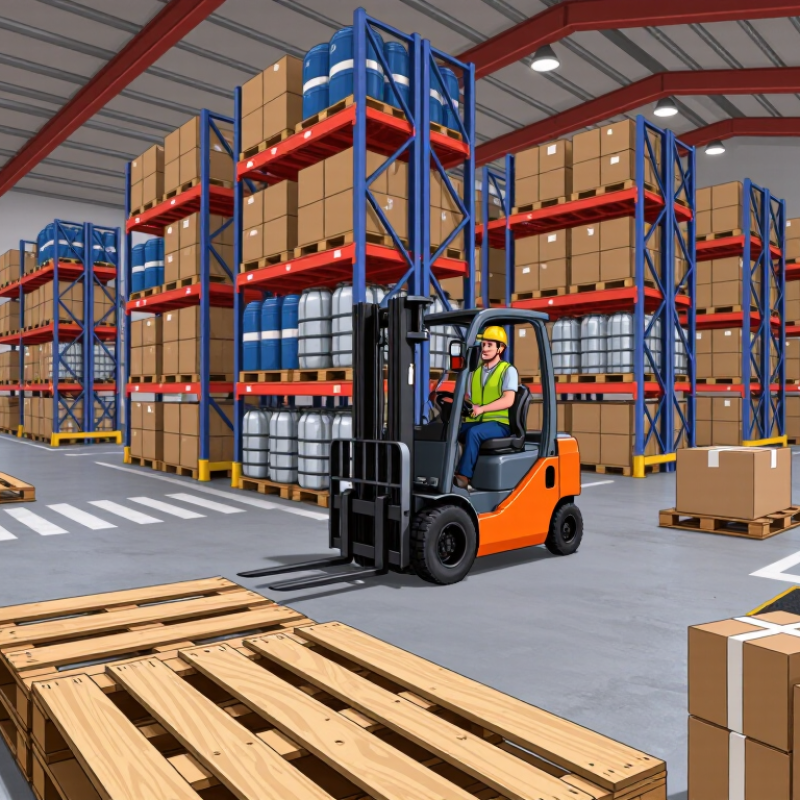
| Counterbalance Forklift | 1,500–5,000 kg | Pallets, machinery, building materials, bulk containers, and irregular loads | General handling Loading and unloading Outdoor work | Requires adequate aisle width, load-bearing floors, marked travel routes, and ventilation for internal-combustion models | Versatile lifting and transport; suitable for docks, yards, and mixed load profiles | Needs trained operators; counterweight increases turning space; combustion models produce emissions and noise | Select electric, LPG, diesel, or other power options according to indoor-air, noise, duty-cycle, and outdoor-use requirements |
| Reach Truck | 1,000–2,500 kg | Pallets stored in selective racking at medium and high elevations | High-density storage Put-away Pallet retrieval | Indoor warehouses with smooth, level floors, stable rack systems, and narrow aisles commonly around 2.5–3.0 m | Uses vertical space efficiently and offers better maneuverability than many counterbalance forklifts | Less suitable for rough outdoor surfaces, ramps, and very irregular loads; residual capacity decreases at greater lift heights | Verify lift height, aisle width, rack beam height, mast configuration, visibility, and floor flatness |
| Very Narrow Aisle Truck | 1,000–1,500 kg | Pallets in high-density storage systems with standardized rack positions | High-throughput storage High-bay picking Pallet handling | Precisely installed racks, smooth floors, guidance systems, and aisles often below 2.0 m depending on configuration | Maximizes storage density and vertical utilization | Usually restricted to dedicated aisles; less flexible for loading docks, open yards, or mixed traffic | Assess rack geometry, guidance method, lift height, floor tolerances, emergency access, and operator protection |
| Order Picker | E-commerce Case picking Store replenishment | Indoor aisles with stable shelving, pedestrian controls, and safety systems for elevated work | Improves access to individual items and supports multi-line order fulfillment | Not intended for heavy pallet transport; elevated platforms require fall protection and operator training | Match platform height, picking frequency, aisle dimensions, load distribution, and access-control requirements |
| Stacker | 600–1,500 kg | Light-to-medium pallets, small loads, and storage in low- to medium-height racks | Small warehouses Back-room storage Occasional stacking | Indoor, level floors; compact aisles; generally shorter travel distances | More economical and compact than many rider forklifts; electric versions produce no local exhaust emissions | Lower travel speed and capacity than counterbalance forklifts; performance can be affected by uneven floors and ramps | Check mast height, stabilizer-leg clearance, pallet type, turning radius, and duty cycle |
| Conveyor System | Application-dependent | Cartons, totes, parcels, trays, and consistently sized unit loads | Continuous flow Sortation Packing lines | Requires a defined layout, suitable power supply, structural support, guarding, and controlled transfer points | Provides predictable, repeatable movement and can reduce manual travel between fixed workstations | Less flexible after installation; unsuitable for highly variable routes or frequently changing product dimensions without adaptable design | Define throughput, product dimensions, accumulation needs, elevation changes, noise limits, guarding, and emergency-stop locations |
| Automated Guided Vehicle (AGV) | Commonly 500–2,000 kg | Standardized pallets, carts, bins, and repeatable production or warehouse loads | Repetitive routes Scheduled replenishment 24/7 operations | Requires defined routes, reliable navigation references, controlled pedestrian interaction, and suitable floor conditions | Automates repetitive transport and can provide consistent movement records and scheduling | Higher implementation complexity; traffic changes, obstructions, and inconsistent load presentation can reduce performance | Evaluate route stability, traffic density, charging strategy, interface points, safety validation, and expected utilization |
| Autonomous Mobile Robot (AMR) | Commonly 300–1,500 kg | Totes, carts, shelves, and pallet loads depending on the platform design | Flexible routing Goods-to-person Variable workflows | Requires mapped operating zones, reliable floor surfaces, safety-rated sensors, and integration with warehouse systems | Can adapt routes around obstacles and support changing warehouse layouts more easily than fixed conveyors | Performance depends on software integration, traffic management, load presentation, and charging availability | Assess payload stability, navigation accuracy, fleet controls, system integration, pedestrian safety, and peak-demand capacity |
| Mobile Scissor Lift Table | Typically 150–1,000 kg | Parts, tooling, cartons, work-in-process materials, and ergonomic workstations | Workstation support Assembly Maintenance | Stable floors with sufficient clearance; lifting height and wheel arrangement must suit the work area | Improves ergonomic positioning and reduces repeated bending or manual lifting | Not designed for long-distance transport or high-throughput pallet movement; requires stability controls | Check platform size, lowered and raised height, load distribution, wheel locks, safety guards, and operating frequency |
| Dock Leveler | Commonly 9,000–30,000 kg distributed load | Forklifts, pallet trucks, and wheeled loads crossing between a dock and vehicle floor | Truck loading Receiving Dispatch | Requires compatible dock height, structural support, drainage planning, and safe vehicle restraint procedures | Bridges height differences and supports safer, faster transfer between vehicles and buildings | Stationary infrastructure with installation and inspection requirements; capacity must account for dynamic wheel loads | Confirm dock height range, lip length, deck capacity, vehicle mix, environmental exposure, and maintenance access |



 08045479132

 Send Inquiry


 Send Inquiry
 Send SMS

