| Base Film | Transparent PET carrier film | Provides dimensional stability during printing, curing, cutting, and transfer. PET offers good flatness, tensile strength, and heat resistance compared with many flexible plastic films. | Typical thickness: 50–100 μm |
| Release Layer | Silicone-based or other controlled-release coating | Controls separation between the carrier film and the printed transfer. A balanced release force helps prevent premature lifting while allowing clean application to the target surface. | Release performance depends on coating formulation and storage conditions |
| Surface Treatment | Corona-treated or coated printable surface | Improves surface energy and ink wetting, helping UV-curable ink form a more uniform image layer and reducing defects such as pinholes or uneven coverage. | Surface energy is commonly controlled above untreated PET levels |
| White Ink Layer | UV-curable white ink containing titanium dioxide pigment | Creates opacity, supports color brightness on dark or transparent substrates, and forms part of the raised 3D visual effect when multiple ink layers are applied. | White ink is normally printed beneath CMYK or color layers |
| Color Ink Layer | UV-curable CMYK or expanded-gamut ink set | Produces the visible image. UV curing polymerizes the ink rapidly under ultraviolet light, allowing the printed pattern to remain on the film during handling and transfer. | Typical curing wavelengths: approximately 365–405 nm |
| 3D Raised Layer | Additional UV ink or clear varnish buildup | Builds tactile relief and visual gloss. The final height depends on the number of passes, ink volume, artwork design, and curing conditions. | Common relief height: approximately 50–300 μm |
| Adhesive Layer | Heat-activated TPU adhesive powder or TPU adhesive coating | Forms the bonding interface between the printed transfer and the substrate. TPU is valued for flexibility, abrasion resistance, and compatibility with many textile and coated surfaces. | Typical powder particle size: approximately 80–200 μm |
| Adhesive Activation | Heat and pressure activation | Heating softens the TPU adhesive so it can wet the receiving surface; pressure improves contact and helps reduce voids at the interface. | Typical activation range: approximately 120–160 °C, depending on adhesive grade |
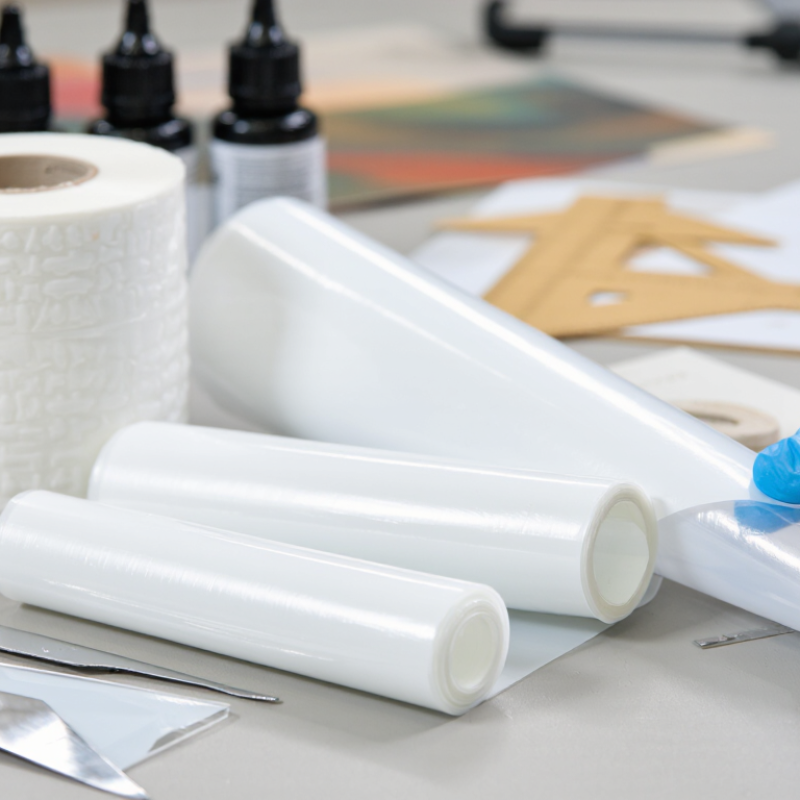
| Film Width | Roll-fed PET film format | Width should match the printer, laminator, or cutting equipment. Stable winding and uniform thickness help reduce tracking problems during continuous processing. | Common commercial widths: 300, 330, 600, and 630 mm |
| Film Length | Roll packaging | Long rolls support continuous production and reduce the number of media changes. Actual roll length is selected according to equipment capacity and handling requirements. | Common roll lengths: 50–100 m |
| Overall Thickness | PET carrier plus release, ink, and adhesive layers | A controlled total thickness supports feeding stability while maintaining flexibility after transfer. Excessive thickness may reduce conformability on curved or textured surfaces. | Often approximately 100–250 μm, depending on the construction |
| Surface Finish | Gloss, matte, or selective clear-gloss finish | The finish influences light reflection, tactile perception, color appearance, and the visibility of raised details. | Gloss finishes provide higher reflectivity; matte finishes reduce surface glare |
| Compatible Substrates | Polyester, cotton blends, coated plastics, leather-like materials, and selected rigid surfaces | Compatibility depends on surface cleanliness, coating chemistry, heat resistance, and the bonding behavior of the TPU adhesive. | Always verify adhesion and wash or abrasion performance on the intended substrate |
| Flexibility | Elastic TPU adhesive and flexible cured ink construction | Supports bending and moderate stretching without immediately cracking when the transfer is properly cured and applied. | Performance varies with ink thickness, substrate elongation, and curing conditions |
| Storage Conditions | Dry, sealed, dust-free environment | Moisture, heat, dust, and direct sunlight can affect release properties, adhesive flow, print quality, and roll flatness. | Common recommendation: 15–30 °C and relative humidity below 70% |
| Quality Control Items | Thickness, width, release force, adhesion, curing, and visual uniformity | Routine inspection helps identify coating streaks, pinholes, color variation, poor powder coverage, edge curl, and transfer failure. | Tests should be conducted with the actual printer, ink, adhesive, substrate, and process settings |



 08045479132

 Send Inquiry


 Send Inquiry
 Send SMS

