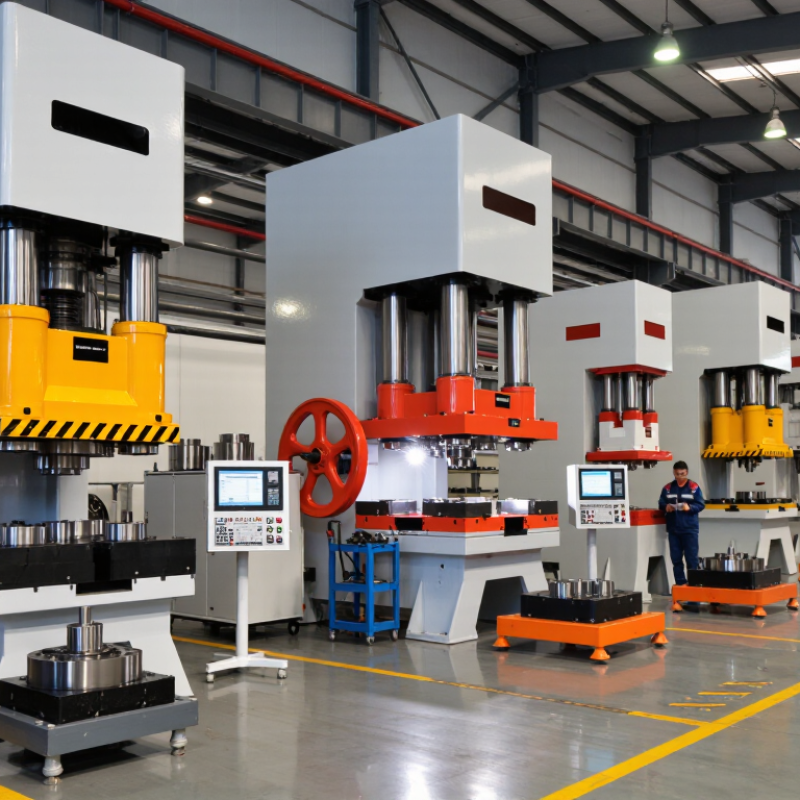
| 1 | Product Classification | Power presses are metal-forming machine tools used for shearing, punching, blanking, bending, and forming sheet or strip metal. | Chinese manufacturers have expanded from conventional mechanical presses to integrated forming lines and digitally controlled equipment. | Confirm the required forming process before comparing machine suppliers. |
| 2 | International Trade Category | Metal-forming machine tools are generally classified under HS heading 8462, which covers machine tools for working metal by forging, hammering, or pressing. | Use of internationally recognized customs classifications has supported cross-border sourcing and export documentation. | Check the exact HS subheading with the customs broker because classification depends on machine design and function. |
| 3 | Machine Force Range | Commercial mechanical power presses are commonly offered from approximately 25 tonnes to more than 1,000 tonnes; the available range varies by machine series. | Domestic production has developed from general-purpose presses toward high-capacity equipment for automotive and heavy-component forming. | Select nominal capacity with an engineering safety margin rather than choosing only by maximum tonnage. |
| 4 | Drive Technologies | Common technologies include eccentric mechanical drives, crankshaft presses, servo presses, and hydraulic forming systems. | Servo-driven systems have introduced more flexible slide motion, while mechanical presses remain widely used for high-speed repetitive production. | Compare speed, energy use, forming accuracy, maintenance, and tooling requirements together. |
| 5 | Electrical and Control Standards | Electrical equipment for machinery supplied to the Chinese market is commonly designed with reference to GB/T 5226.1-2019, which is aligned with IEC 60204-1 principles. | Control systems have progressed from relay-based operation to PLC, HMI, servo, and network-connected production control. | Request the electrical schematic, control-component list, software backup, and language options before ordering. |
| 6 | Machine Safety | Press safety evaluation commonly considers guarding, emergency stops, two-hand controls, light curtains, die protection, and safe stopping performance. ISO 16092-1:2017 is a relevant international press-safety reference. | Safety design has become more important as factories move toward automated lines and international compliance requirements. | Safety functions should be verified through documentation, testing, and risk assessment rather than by appearance alone. |
| 7 | Automation Compatibility | Typical press-line accessories include decoilers, straighteners, servo feeders, transfer systems, conveyors, sensors, and die-change equipment. | Manufacturers increasingly supply complete press lines instead of standalone machines, improving material flow and reducing manual handling. | Evaluate interface protocols, line synchronization, tooling access, and after-sales support for the complete line. |
| 8 | Main Application Sectors | Major applications include automotive components, household appliances, electrical enclosures, electronics hardware, construction hardware, and general metal fabrication. | Demand has shifted from basic fabrication toward higher repeatability, faster changeovers, and automated production for large-volume industries. | Ask for application references using similar materials, part sizes, tooling, and production rates. |
| 9 | Manufacturing Development | China’s machine-tool industry expanded significantly after the country joined the World Trade Organization in 2001, while industrial modernization policies later encouraged automation and advanced manufacturing. | The supply chain has become broader, covering castings, transmissions, electrical controls, tooling, automation, and export services. | Assess the supplier’s engineering depth and component traceability, not only the machine’s purchase price. |
| 10 | Key Supplier-Selection Metrics | Important comparison factors include verified force accuracy, repeatability, cycle speed, energy consumption, safety compliance, spare-parts availability, installation capability, and warranty terms. | The market has become more competitive, making measurable performance and lifecycle service more useful than broad claims about production scale. | Use factory audits, sample-part trials, acceptance tests, and total-cost-of-ownership calculations when ranking manufacturers. |



 08045479132
 Send Inquiry

 Send Inquiry
 Send SMS