| Purpose | An active balancer helps reduce differences in charge among cells connected in series. | Balancing can help keep cells within their permitted voltage limits and make more of the pack’s capacity usable. |
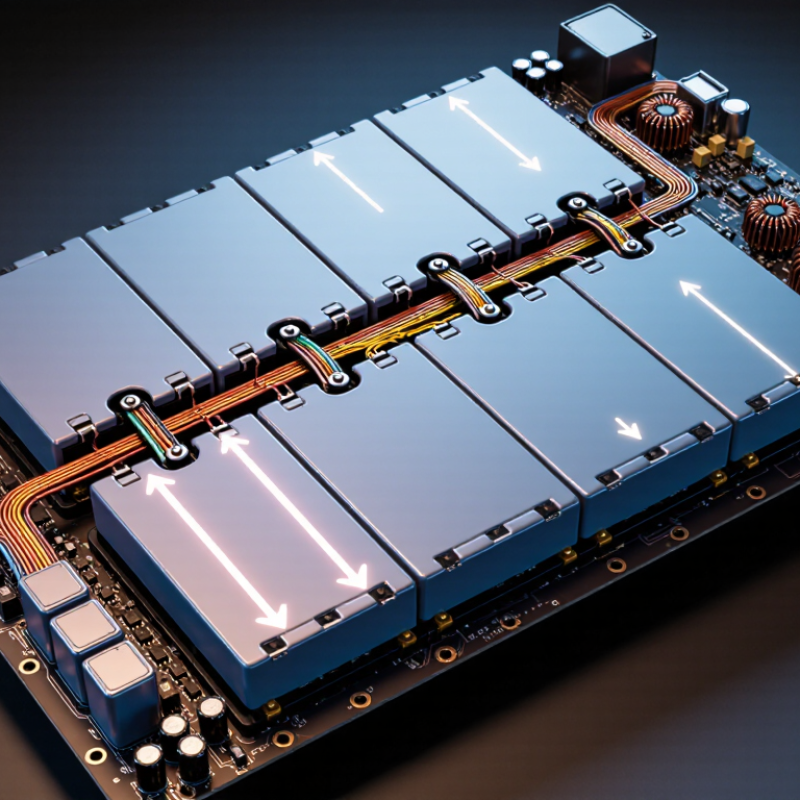
| Energy transfer | Rather than dissipating most of the excess energy as heat, an active circuit moves energy from a higher-charge cell or cell group toward a lower-charge one. | The energy is transferred through power-conversion components; it does not travel directly between cells without a circuit. |
| Common circuit methods | Depending on the design, switching capacitors, inductors, or transformer-based converters can move energy between cells or between a cell and the pack. | Topology determines which cells can exchange energy, the transfer rate, circuit complexity, and balancing losses. |
| Monitoring and control | The BMS measures cell voltages and may use current, temperature, and battery-model information to decide when balancing is appropriate. | Voltage is a useful indicator, but it does not always correspond precisely to state of charge—especially while current is flowing or for chemistries with a flat voltage curve. |
| When balancing starts | The controller applies its configured balancing conditions, which may include a cell-voltage difference, operating state, and temperature limits. | Start thresholds and allowable conditions vary by battery chemistry, cell specifications, and BMS design; there is no single universal threshold. |
| Illustrative cell readings | For a series pack with cell readings of 3.70 V, 3.66 V, 3.64 V, and 3.62 V, the controller may identify the higher-reading cell as a candidate energy source. | This is an example of measured voltage, not a guaranteed ranking of state of charge. Rest time, load, temperature, and cell characteristics affect interpretation. |
| Active vs. passive balancing | Active balancing transfers energy to other cells. Passive balancing uses resistors to discharge selected higher-voltage cells, converting energy mainly into heat. | Active designs can reduce balancing energy lost as heat, but generally require more circuitry and control than a simple passive balancer. |
| Balancing direction | Energy moves from a cell or group with relatively more charge toward a cell or group with relatively less charge, according to the circuit’s available transfer paths. | Not every active balancer can transfer energy between every pair of cells; the specific topology sets the available paths. |
| What balancing cannot do | Balancing does not repair damaged cells or make cells with different capacities identical. | Persistent imbalance can indicate capacity variation, aging, leakage, connection issues, or measurement problems and may require investigation. |
| Safe operation | The BMS should coordinate balancing with cell-voltage and temperature protections and follow the cell manufacturer’s operating limits. | Balancing is not a substitute for correct cell selection, wiring, fusing, thermal management, or pack-level protection. |



 08045479132

 Send Inquiry


 Send Inquiry
 Send SMS

