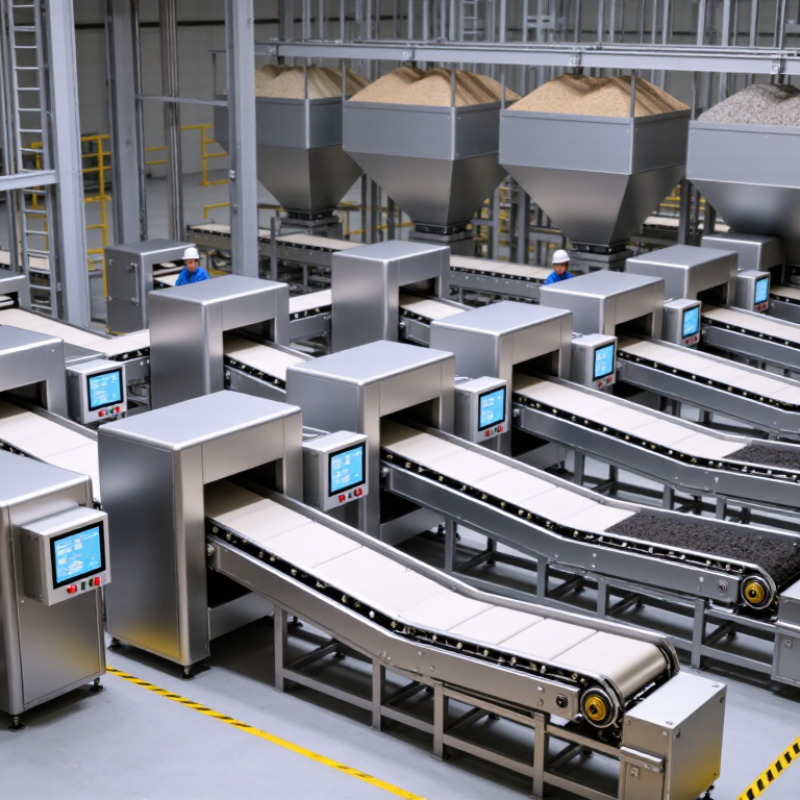
| Continuous belt weigh feeder | A material-carrying belt passes over a weighing section; belt load and belt speed are used to calculate and control mass flow. | Granules, pellets, powders, and other bulk solids in continuous conveying and process dosing. | Check belt width and speed range, material flow consistency, weighing-section layout, belt tracking, and access for cleaning and maintenance. |
| Apron weigh feeder | Overlapping metal pans or plates carry material from a hopper, with weighing and speed control used for controlled extraction. | Heavy, abrasive, hot, or coarse bulk materials, including applications beneath storage hoppers. | Assess material lump size, impact loading, pan and chain wear, hopper interface, drive capacity, and required maintenance access. |
| Screw weigh feeder | A rotating screw moves material through a trough or tube; a gravimetric design measures weight and adjusts screw speed to regulate feed rate. | Powders and small, free-flowing solids used in batching or continuous process feeding. | Review material flowability, screw geometry, flight wear, risk of bridging or buildup, sealing needs, and whether the application needs gravimetric rather than volumetric control. |
| Twin-screw gravimetric feeder | Two rotating screws provide positive material movement, while weight measurement and speed control regulate the discharge rate. | Materials that are cohesive, difficult to feed, or prone to bridging; also used for some mixed or aerated powders. | Confirm screw design for the specific material, required cleanout method, sealing and dust-control arrangements, and access to wear parts. |
| Loss-in-weight feeder | A hopper and feeding device are mounted on a weighing system; the rate of weight loss is measured and feeder speed is adjusted to meet the setpoint. | Accurate continuous dosing of powders, pellets, flakes, and other ingredients in process lines. | Consider refill strategy, refill-related flow changes, hopper capacity, vibration isolation, material refill behavior, and integration with the control system. |
| Vibratory gravimetric feeder | Controlled vibration conveys material along a tray; a weighing system monitors output and regulates vibration to adjust feed rate. | Free-flowing granules, fragile products, and materials for which screw or belt contact may be undesirable. | Check material response to vibration, required feed-rate turndown, mounting and isolation, noise limits, and the effects of nearby equipment vibration. |
| Compact weigh-belt feeder | A short, compact belt section combines belt weighing and speed control in a space-efficient feeder assembly. | Light or granular materials in packaging, blending, and process-dosing systems with limited installation space. | Verify that the belt and weighing arrangement suit the material load, available headroom, cleaning frequency, and upstream material presentation. |
| Heavy-duty belt weigh feeder | A reinforced belt and robust drive transport bulk solids while a weighing section and speed control regulate continuous flow. | Higher-load industrial applications involving bulk solids such as minerals, aggregates, or process materials. | Evaluate impact and abrasion, belt support and tensioning, loading conditions, environmental protection, and service access for the drive and belt. |
| Sanitary gravimetric feeder | A gravimetric feeding system designed with product-contact surfaces and construction features suited to hygienic cleaning requirements. | Food, pharmaceutical, and other processes where product-contact hygiene and controlled dosing are important. | Specify the required cleaning method, surface finish, material compatibility, access for inspection, and applicable site or industry hygiene requirements. |
| Micro-ingredient weigh feeder | A small-capacity gravimetric system measures and controls the delivery of low-rate ingredients, often using a compact screw or similar metering device. | Minor ingredients, additives, colorants, and other low-throughput dosing tasks in batch or continuous processes. | Check minimum and maximum feed rates, resolution and repeatability requirements, ingredient containment, refill method, and calibration procedure. |



 08045479132

 Send Inquiry


 Send Inquiry
 Send SMS

