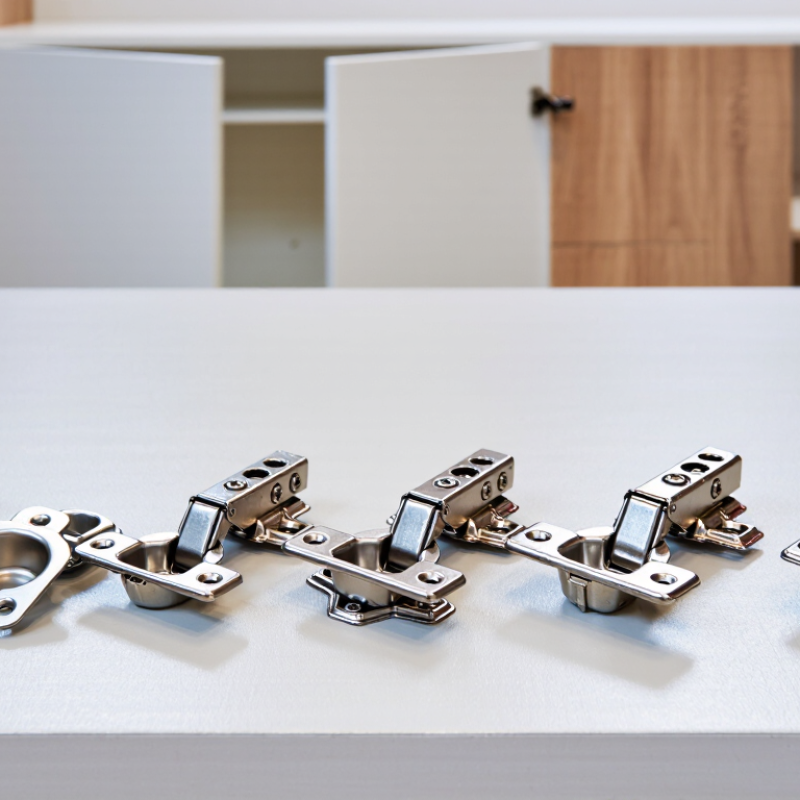
| Concealed European Hinge | Full-overlay, half-overlay, and inset cabinet doors | Commonly 100°–110°; wider-angle versions are available | Requires a cup boring operation in the door; many models offer three-way adjustment | Clean appearance, concealed hardware, easy alignment, and broad compatibility with modern cabinetry | Requires accurate drilling and sufficient door thickness around the cup area | Choose it when appearance, adjustability, and repeatable installation are priorities | Excellent for most modern cabinets |
| Soft-Close Concealed Hinge | Frequently used on kitchen, bathroom, office, and storage cabinet doors | Usually about 100°–110°, depending on the design | Installed like a concealed hinge; integrated damping controls the final closing movement | Reduces slamming, noise, vibration, and stress on the cabinet box and door | Generally costs more; the damper may need adjustment or replacement over time | Choose it for quiet operation, family kitchens, and frequently used doors | Best for comfort and noise reduction |
| Self-Closing Concealed Hinge | Overlay and inset doors that should return to the closed position | Commonly 100°–110° | Uses an internal spring; installation is similar to other concealed cup hinges | Helps keep doors closed without a separate catch or magnetic device | Closing force can make the door feel less gentle; very heavy doors may require suitable hinge capacity | Choose it when reliable closing is more important than the softest closing action | Very good for everyday storage cabinets |
| Butt Hinge | Traditional framed cabinets, furniture doors, and visible or semi-visible installations | Often approximately 90°–180°, depending on the leaf and stop design | Mounted to the door and cabinet with screws; accurate positioning is important | Simple construction, strong load support, and a classic furniture appearance | Usually visible; may require mortising or careful preparation; limited adjustment after installation | Choose it for traditional styling, robust construction, or furniture-style cabinetry | Best for traditional and furniture designs |
| Piano Hinge | Long, narrow doors, continuous cabinet fronts, boxes, and access panels | Often close to 180°, subject to the hinge geometry and surrounding clearance | Runs along much of the door edge and is attached with multiple screws | Distributes load along the full length and helps reduce localized stress | Visible along the edge; alignment must be accurate over the entire hinge length | Choose it when continuous support and a long, straight hinge line are required | Best for long or narrow doors |
| Pivot Hinge | Inset doors, frameless panels, glass doors, and minimalist cabinet designs | Varies by model; some designs allow wide or near-full opening | Mounted at pivot points, commonly near the top and bottom of the door | Creates a discreet appearance and can support distinctive door movement | Needs precise top-and-bottom positioning; door weight and clearance must be checked carefully | Choose it for design flexibility, inset doors, or a minimal visible-hardware effect | Best for specialized and minimalist installations |
| Glass-Door Hinge | Glass cabinet doors and display cabinets | Commonly 90°–110°, depending on the hinge design | Some models clamp or insert into prepared glass; drilling requirements depend on the hardware | Designed to hold glass without requiring a conventional wooden hinge cup | Glass thickness, edge condition, load rating, and clearance must match the hinge specifications | Choose it only after confirming glass thickness, door weight, and mounting method | Best for glass display doors |
| Surface-Mount Hinge | Cabinet doors where drilling a concealed hinge cup is unsuitable | Often approximately 90°–180°, depending on the hinge and stop design | Attaches directly to the cabinet and door surfaces; generally simpler to install | Useful for retrofit work, thin doors, and projects with limited tooling | Hardware remains visible; adjustment range is usually smaller than that of a European hinge | Choose it when easy installation or preservation of the door material is important | Best for retrofit and simple repairs |
| Inseparable Security Hinge | Cabinet doors requiring additional resistance to removal when closed | Varies by model, commonly within a standard cabinet-door opening range | Installed similarly to a surface or butt hinge, with a design that limits pin removal | Improves resistance to unauthorized hinge-pin removal | May be more visible and less adjustable; unnecessary for ordinary indoor cabinets | Choose it for utility, service, or storage areas where security is a specific concern | Best for security-focused applications |
| Spring-Loaded Hinge | Doors that need automatic closing without a separate closing mechanism | Depends on the hinge design and built-in stop | Requires correct spring tension and secure mounting to prevent uneven closing | Provides automatic return action and can help keep a door shut | May close abruptly; excessive tension can increase stress on the door and mounting points | Choose it when automatic closing is needed and soft-close performance is not essential | Good for functional utility doors |
| Heavy-Duty Concealed Hinge | Large, thick, or heavier-than-standard cabinet doors | Frequently 100°–120°, depending on the model | Requires accurate cup drilling and mounting; the rated load must be verified for the complete door | Offers concealed styling while supporting higher door loads than standard light-duty hardware | Usually needs stronger mounting material and may require more installation clearance | Choose it according to door weight, height, thickness, material, and hinge quantity | Best for oversized or heavy doors |
| Small-Angle or Restricted-Opening Hinge | Cabinets beside walls, appliances, corners, or other areas with clearance limits | Typically restricted to a specified angle below a wide-opening hinge | Installed according to the cabinet overlay or inset configuration; the opening limit must be checked before fitting | Prevents the door from striking adjacent surfaces or equipment | Provides less access to the cabinet interior and is not suitable where a wide opening is required | Choose it after measuring nearby walls, handles, appliances, and door swing clearance | Best for clearance-limited locations |
| Adjustable Clip-On Concealed Hinge | Modular kitchen and storage cabinets requiring convenient door removal | Commonly 100°–110° | Uses a mounting plate and clip mechanism; the door can often be removed without fully removing the screws | Speeds up installation, servicing, cleaning, and door replacement | Clip and plate compatibility must be confirmed; incorrect engagement can affect safety and alignment | Choose it for cabinets that need frequent maintenance or efficient assembly | Best for easy servicing and installation |



 08045479132
 Send Inquiry

 Send Inquiry
 Send SMS