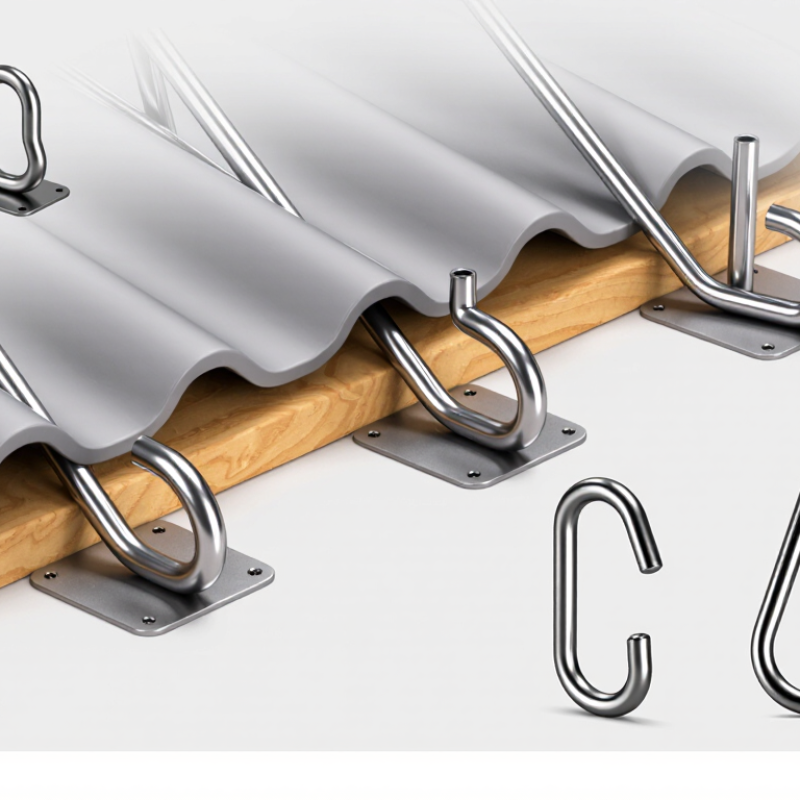
| Fixed tile roof hook | Concrete or clay tile roofs, where the hook can pass beneath the tile and attach to structural roof framing. | Commonly stainless steel grades such as 304 or 316; confirm the specified grade and applicable product documentation. | Fixed geometry; requires the correct hook height and offset for the tile profile and roof structure. | Simple configuration when the roof covering, rafter position, and mounting rail align with the hook design. | Check tile clearance, flashing or waterproofing details, attachment into structural framing, and whether the tile needs modification. |
| Adjustable tile roof hook | Tile roofs with variation in batten height, tile profile, or rail position. | Compare the stainless grade of the hook and the materials of bolts, washers, and other connected parts. | Slotted or multi-position features can allow on-site alignment; the available adjustment is product-specific. | Can make rail alignment easier where roof geometry varies, provided the adjustment is set and secured as specified. | Confirm adjustment range, fastener arrangement, installation instructions, and that adjustment does not compromise structural attachment. |
| Slate roof hook | Natural or manufactured slate roofs, using a hook designed for the roof build-up and slate layout. | Grade selection depends on exposure and project requirements; 316 contains molybdenum and is often considered for more corrosive environments. | Usually selected to suit slate thickness, course spacing, and the intended attachment point. | A purpose-designed profile can reduce interference with adjacent slates when installed correctly. | Check slate condition, fixing method, water-shedding details, and any requirements for specialist slate-roof installation. |
| 304 stainless steel option | A common comparison grade for many general-purpose exterior applications, subject to the project environment. | Austenitic stainless steel; 304 is commonly described as an 18/8 grade, referring approximately to its chromium and nickel content. | Hook shape and adjustment are separate design choices; grade alone does not determine fit. | Widely used and a useful baseline when comparing material declarations and project suitability. | Evaluate local exposure, including coastal salt, industrial pollutants, and trapped moisture; do not choose by grade name alone. |
| 316 stainless steel option | Projects where increased resistance to chloride-related corrosion is a consideration, including some coastal or salt-exposed locations. | Austenitic stainless steel containing molybdenum; exact composition and certification should be confirmed from the supplier documentation. | Available hook geometry and adjustment depend on the specific design, not simply on the stainless grade. | Molybdenum improves resistance to chloride corrosion compared with 304 in many conditions, though it does not make the material corrosion-proof. | Consider the entire assembly, including fasteners and dissimilar-metal contact; follow project specifications and exposure guidance. |
| Load capacity and structural design | All roof types and hook configurations. | Material grade is only one factor; geometry, thickness, fasteners, substrate, and installation all affect performance. | No universal load value applies to every hook or roof assembly. | Comparing documented design values and test conditions is more meaningful than comparing appearance alone. | Use project-specific wind and snow loads, roof framing details, approved installation instructions, and applicable local codes. Have the design verified by a qualified professional. |



 08045479132

 Send Inquiry


 Send Inquiry
 Send SMS

