| Whisk head | Food-contact silicone-coated stainless-steel wires; alternatively, all-silicone loops without a metal core. | A metal core generally helps the wires retain their shape and provide whisking tension. Unreinforced loops may be more flexible, while their stiffness and durability depend on design and silicone formulation. | Inspect wire symmetry, coating coverage, loop spacing, and shape recovery after repeated bending. Check that no metal is exposed at tips or joins. |
| Wire core | Stainless steel is commonly used as the internal support in coated-wire whisks. The steel grade should be specified by the supplier rather than assumed. | Core stiffness affects control and mixing response. Corrosion resistance depends on the steel grade, processing, and exposure conditions. | Request the declared steel grade and corrosion-related documentation where relevant. Inspect cut ends and attachment points for rust, burrs, or exposed core. |
| Silicone coating | Silicone elastomer formulated for food-contact applications, applied over the whisk wires. | The coating helps reduce direct metal contact with cookware, but thin, uneven, damaged, or poorly bonded coating can wear or separate in use. | Check coating continuity and thickness consistency visually; use repeated-use and cleaning tests to assess peeling, cracking, discoloration, and exposed wire. |
| Heat performance | Temperature limits are product- and formulation-specific; silicone kitchen tools may have different stated limits from one supplier to another. | Heat exposure can affect the silicone, handle, and joints differently. A generic silicone temperature claim does not establish the limit of the complete whisk. | Obtain the supplier’s stated maximum and minimum use temperatures for the finished product. Confirm test conditions and assess the handle and joint as well as the whisk head. |
| Handle material | Common options include silicone-covered handles, polypropylene handles, and stainless-steel handles. | Handle material influences grip, weight, heat transfer, cleaning, and perceived durability. Performance also depends on shape, surface finish, and how the handle is joined to the head. | Compare grip comfort with wet hands, balance, surface finish, and handle deformation after the supplier’s recommended heat and cleaning conditions. |
| Head-to-handle joint | Examples include a mechanically secured wire bundle, an overmolded connection, or a bonded connection. | The joint is a potential weak point. A secure, well-finished connection helps resist loosening and can reduce gaps where food or water may collect. | Check for movement, visible gaps, sharp edges, and residue traps. Conduct repeated stirring and washing cycles, then recheck the joint for looseness or separation. |
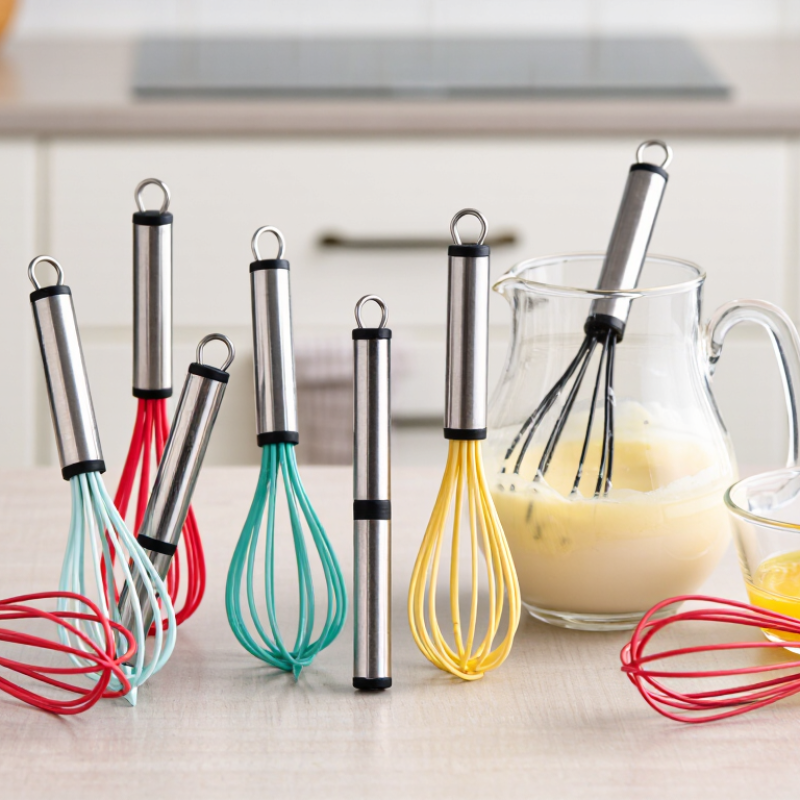
| Whisk sizes in a set | A set may combine different head lengths or shapes, such as balloon-style and compact whisks; exact dimensions should be stated for each piece. | Different sizes support different bowl sizes and tasks. A set with clearly differentiated sizes is easier to merchandise and use than pieces with minimal functional distinction. | Request head length, overall length, and wire-span measurements in millimetres or inches. Confirm that each size has a defined use and consistent dimensions across production lots. |
| Cookware contact | Flexible, silicone-coated wires are commonly selected for use with coated cookware, subject to the cookware maker’s care instructions. | Silicone coating can reduce direct metal contact, but it does not guarantee that a whisk will never mark cookware. Wear, exposed wire, pressure, and coating condition matter. | Test samples on representative cookware using normal mixing pressure. Inspect both the whisk coating and cookware surface after repeated use. |
| Cleaning and hygiene | Cleaning suitability depends on the finished product, including the handle and joint, not only the silicone material. | Smooth surfaces and accessible joints are easier to inspect and clean. Dishwasher suitability should be supported by product-specific instructions or testing. | Request care instructions and dishwasher-cycle evidence if dishwasher-safe claims are planned. Check for water retention, trapped food, and changes after repeated washing. |
| Food-contact documentation | Compliance requirements depend on the destination market and the product’s materials and intended conditions of use. | Material names alone do not establish regulatory compliance. Documentation should relate to the finished article and its intended food-contact conditions. | Identify target markets before purchase. Request applicable declarations, test reports, and traceability documents; confirm that they cover the supplied materials and product configuration. |
| Wholesale quality control | Sample inspection and production checks can cover dimensions, appearance, assembly, packaging, and functional performance. | Defined acceptance criteria help keep production lots consistent and make defects easier to identify before shipment. | Agree on measurable specifications, sampling plans, defect criteria, packaging requirements, and any required pre-shipment inspection before confirming an order. |



 08045479132

 Send Inquiry


 Send Inquiry
 Send SMS

