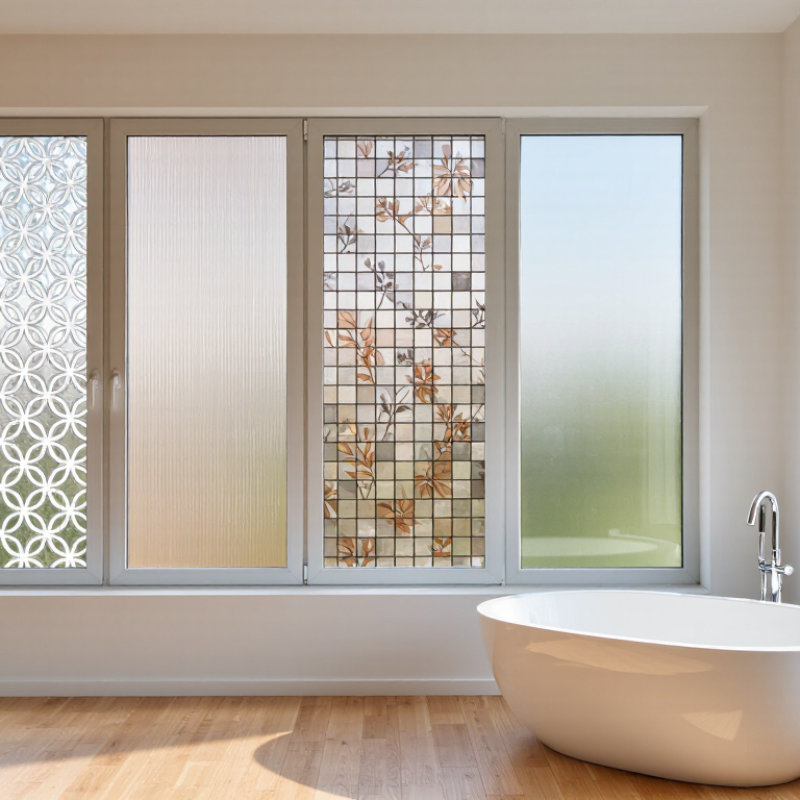
| Frosted Film | Soft, translucent finish for bathrooms, entry doors, and office partitions; admits daylight while obscuring details. | High for visual detail at close range; silhouettes may still be visible in some lighting. | Clean with a soft cloth and mild soapy water. Avoid abrasive pads and sharp tools. | Adhesive versions can last for years indoors when correctly installed and protected from edge damage. | Does not block all light or provide soundproofing. Privacy can vary with distance, lighting, and film opacity. |
| Etched-Glass-Effect Film | Imitates the refined look of etched glass, often with clear and frosted patterns; suitable for decorative panels and meeting rooms. | Ranges from low to high depending on the pattern and the amount of covered glass. | Use a non-abrasive cloth and mild cleaner; take care around pattern edges. | Performance depends on film material, installation, sunlight exposure, and cleaning methods. | Patterned sections may leave clear sightlines. It offers a visual effect rather than actual glass etching. |
| Gradient or Transitional Film | Shifts from more opaque to more transparent; useful for glass partitions where privacy is needed at eye level. | Moderate to high in the covered zone; lower where the film fades or ends. | Wipe gently with a soft, non-abrasive cloth and mild cleaning solution. | Large, uninterrupted areas may show installation marks if the glass is not prepared and the film is not applied carefully. | Provides partial, not full-height privacy. The transition may not align with every viewer’s eye level. |
| Decorative Pattern Film | Geometric, floral, or other repeating designs add visual interest to windows, cabinets, and interior dividers. | Varies widely; dense patterns obscure more than open or widely spaced designs. | Dust regularly and clean with a soft cloth. Avoid scraping across printed or textured areas. | Printed designs may fade or wear sooner under strong direct sunlight or frequent contact, depending on film quality. | Open areas in the design remain see-through. A pattern can also reduce the view or slightly dim incoming light. |
| Colored or Stained-Glass-Effect Film | Adds color and decorative light effects to windows, sidelights, or cabinet glass. | Usually low to moderate; privacy depends on color, opacity, and pattern density. | Use mild cleaner and a soft cloth; avoid abrasive products that can scratch the surface. | Color stability varies. Prolonged direct sun can contribute to fading in some films. | May change the color of daylight and the view outdoors. It does not reproduce the texture or light transmission of real stained glass exactly. |
| Static-Cling Film | Adhesive-free option for temporary decoration or privacy, often suitable for renters and seasonal use. | Depends on the film design and coverage; can provide substantial visual screening when opaque or frosted. | Many versions can be removed, repositioned, and washed according to the product instructions. | Can be reused, but dust, handling, and repeated application may reduce its grip over time. | May not adhere well to textured, dirty, or unsuitable glass. Edges can lift, especially in humid areas or where frequently touched. |
| One-Way Mirror Film | Reflective finish often used to reduce daytime visibility into rooms while retaining an outward view. | Can offer daytime privacy when the exterior is brighter than the interior. | Clean gently with a soft cloth and a cleaner approved for the film; avoid scratching the reflective surface. | Exposure to sunlight, heat, and moisture can affect longevity; suitability depends on the glass and film specification. | Privacy is not reliable at night when interior lights are brighter. It does not replace blinds or curtains for consistent privacy. |



 08045479132

 Send Inquiry


 Send Inquiry
 Send SMS

