| Entry-Level Semi-Automatic CNC Lathe | Small repair shops handling occasional diamond-cut wheel work | Commonly configured for passenger-car wheels in the approximate 12–24 in range; capacity depends on the machine’s swing and fixture | Operator sets the cutting path or parameters; CNC controls the programmed tool movement | Lower-cost entry to repeatable resurfacing; suitable for relatively straightforward face designs | Check supported wheel diameter and width, setup time, guarding, training, and whether scanning or programming is included |
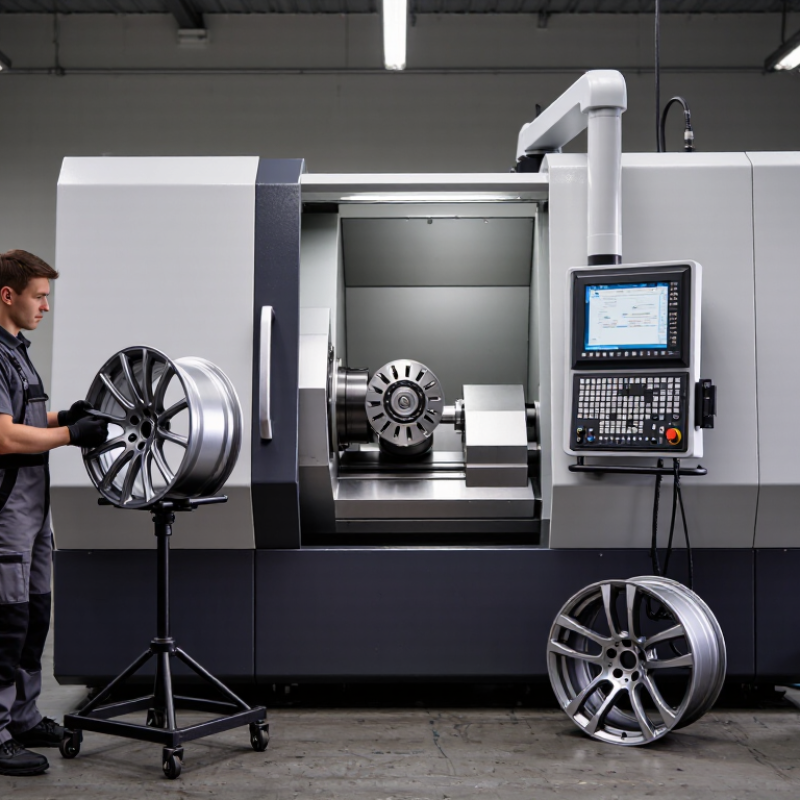
| General-Purpose CNC Diamond-Cut Lathe | Independent wheel-refurbishment shops with regular passenger-car jobs | Many configurations accommodate approximately 12–30 in wheels; confirm maximum wheel width and weight separately | CNC-controlled cutting tool follows a programmed path while the wheel is securely mounted and rotated | Versatile option for common flat-face and machined-face wheel profiles; balances capability and floor-space needs | Review spindle and fixture specifications, tool access, software workflow, service support, and the exact usable work envelope |
| Multi-Axis CNC Wheel Lathe | Shops handling varied spoke shapes and more complex wheel-face geometry | Capacity varies by model; passenger-wheel configurations commonly cover a broad range up to around 30 in | Additional controlled axes allow more flexible tool positioning and cutting-path movement | Can accommodate a wider variety of profiles than a basic setup when supported by suitable programming and tooling | Ask which axes are simultaneously controlled, what shapes can be cut, and whether the software supports the intended wheel designs |
| Scan-Guided CNC Lathe | Shops seeking to reduce manual profile measurement and programming work | Determined by the lathe’s work envelope; scanning capability does not increase the machine’s maximum wheel size | A probe or optical scanner captures wheel-face geometry; software uses the scan to help create a cutting path | Can help reproduce an existing face profile and simplify setup for unfamiliar designs | Check scanner type, scan coverage, software compatibility, operator review steps, and performance on damaged or reflective surfaces |
| Portable or Compact Wheel Lathe | Mobile repair services or workshops with limited floor space | Usually designed around a more restricted wheel-size and weight range; verify the actual limits before purchase | Compact mounting and clamping arrangement; some systems are designed to work close to the vehicle or in a mobile setup | Can reduce transport of wheels to a separate machine when the system and job are suitable | Check mounting method, stability, power requirements, safe operating clearances, and which repairs can be performed on-site |
| Combined Lathe and Milling System | Refurbishers who need both face cutting and additional machining operations | Varies by configuration; confirm capacity for each operation, not just the stated maximum wheel diameter | Combines a lathe-style cutting setup with a milling capability or interchangeable machining arrangement | Can support a broader range of repair and finishing tasks than a single-purpose lathe | Compare changeover time, available tooling, guarding, software functions, and whether both operations meet the shop’s quality requirements |
| Automated or Production-Cell CNC System | High-throughput refurbishment operations with consistent job volume | Defined by the cell’s lathe, loading equipment, and wheel-handling fixtures; confirm the full system envelope | CNC cutting may be integrated with automated loading, measurement, or material handling | Can reduce repetitive handling and support more consistent production workflows when jobs are standardized | Evaluate throughput under real job conditions, operator supervision, cell footprint, safety interlocks, integration, and maintenance needs |
| Specification note: Capacity figures above are indicative ranges for common passenger-wheel equipment, not guaranteed specifications. Actual limits depend on the machine, clamping system, tooling, wheel design, and operating procedure. Confirm the manufacturer’s rated wheel diameter, width, weight, electrical requirements, and safety documentation before purchase. |



 08045479132

 Send Inquiry


 Send Inquiry
 Send SMS

