| Wall thickness | Nominal walls of 2.0–3.0 mm for a small handheld or wall-mounted enclosure | Thicker walls can improve rigidity and resistance to handling loads. Adequate thickness around bosses and fasteners helps reduce cracking. | More material can increase weight, cost, molding time, and the risk of sink marks or uneven cooling. | Check the actual part geometry, molding guidance, fastening loads, and prototype stiffness. |
| Ribbing and corner radii | Internal ribs, reinforced mounting bosses, and rounded internal corners | Well-designed ribs can add stiffness without making every wall uniformly thicker. Rounded corners help reduce local stress concentrations. | Overly thick ribs or abrupt transitions may cause sink marks, warpage, or stress concentrations. | Review rib-to-wall proportions, draft, boss design, and molded-part samples. |
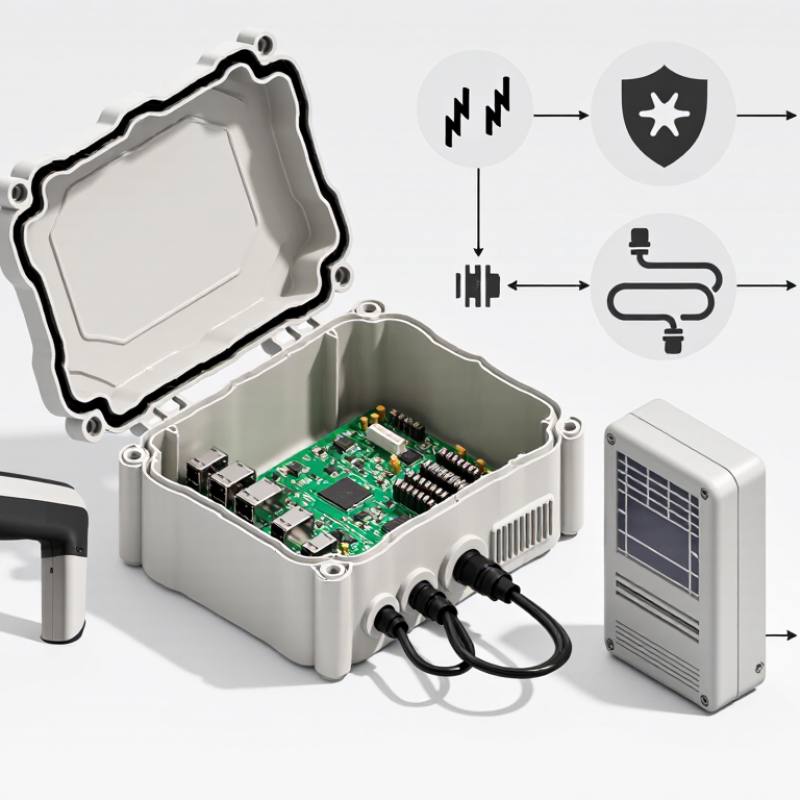
| Gasket and lid interface | Designed groove with a compatible elastomer gasket and controlled screw spacing | Can help limit dust and water ingress when the enclosure, gasket, fasteners, and assembly process are designed together. | A gasket alone does not establish an ingress-protection rating. Poor compression, joints, or cable entries can create leak paths. | Test the fully assembled product to the intended ingress-protection standard and test conditions. |
| Flame-retardant ABS grade | Specify a resin grade with a required flammability classification at the relevant test thickness | May improve resistance to ignition or flame spread under the conditions of the applicable material test. | Flame-retardant grades can differ in impact strength, flow, color, and processing behavior. A material rating does not automatically certify the finished device. | Confirm the exact resin grade, tested thickness, current material documentation, and product-level requirements. |
| UV-stabilized material or coating | UV-stabilized ABS grade or a compatible protective coating for light exposure | Can help reduce weathering effects such as discoloration or surface degradation, depending on the formulation and exposure. | Unmodified ABS may weather under prolonged outdoor exposure. UV resistance does not by itself make an enclosure weatherproof. | Request exposure data for the selected material or coating and evaluate the intended environment and service life. |
| Ventilation openings | Slotted vents or a membrane vent selected for the thermal and environmental requirements | Open vents can improve airflow and help dissipate heat; a suitable membrane vent may equalize pressure while limiting liquid entry. | Openings can reduce protection from dust and water. A vent membrane has defined operating limits and must be installed correctly. | Measure internal temperatures under worst-case load and test the complete enclosure with the selected vent. |
| EMI shielding treatment | Conductive internal coating or a conductive liner applied to selected enclosure surfaces | May improve electromagnetic shielding when the coating, seams, lid contact, and grounding are engineered as a continuous system. | Performance depends on frequency, coating coverage, contact resistance, and assembly. Standard ABS is electrically insulating. | Test the assembled product across its relevant frequency range; check seam continuity and grounding design. |
| Connector cutouts and cable entries | Custom openings aligned to connectors, switches, cable glands, and strain reliefs | Accurate cutouts can improve fit, serviceability, and cable routing while reducing unnecessary openings. | Cutouts can weaken nearby walls and create ingress or stress points if clearances and sealing features are inadequate. | Check connector tolerances, edge clearances, cable loads, sealing details, and assembly access. |
| Mounting features | Integral bosses, inserts, standoffs, or external mounting tabs | Can improve board positioning and installation repeatability when sized for the fasteners and expected loads. | Repeated tightening, excessive torque, or unsuitable screw selection can damage plastic bosses or inserts. | Validate fastener type, boss geometry, installation torque, and repeated-assembly requirements. |
| Surface finish and color | Textured, smooth, or molded-in color finish | Can affect appearance, scratch visibility, grip, and how fingerprints or minor surface defects are perceived. | Finish, color, and resin choice may affect visual consistency between production batches; coatings may add process steps. | Approve production-representative samples and specify color and finish acceptance criteria. |



 08045479132

 Send Inquiry


 Send Inquiry
 Send SMS