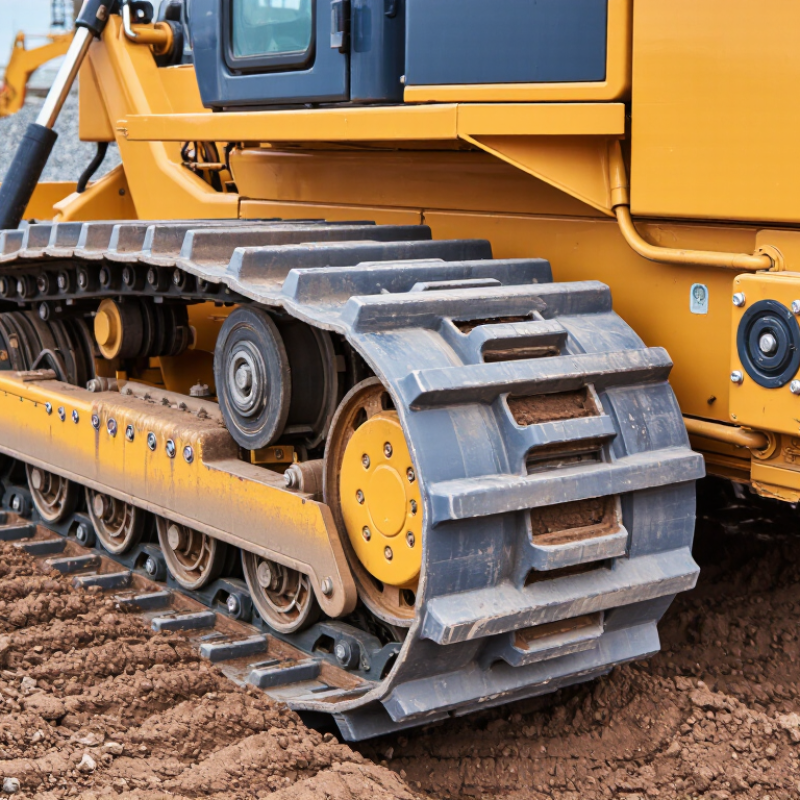
| 1 | Double-flange bottom roller | Lower track frame | Supports the track frame against the inner track surface; the flanges help guide the track. Bottom rollers carry part of the machine’s operating weight, with the load shared among rollers. | Confirm flange profile, dimensions, mounting pattern, shaft and seal arrangement, and the machine’s specified part number. | It has no standalone ROC rating under ISO 14397-1. Roller loads depend on the loader’s undercarriage design and operating conditions. |
| 2 | Single-flange bottom roller | Lower track frame, where specified | Supports and guides the track in undercarriage designs that use a single-flange arrangement. It is not automatically interchangeable with a double-flange roller. | Match the flange location and track-frame position to the parts specification; check track alignment and wear patterns. | Machine ROC describes loader lifting capacity, not the permissible load of an individual roller. |
| 3 | Position-matched bottom roller | Front, center, or rear position on the lower frame | Some undercarriages specify different roller parts or arrangements by position. Impacts and load distribution can vary with terrain, attachment, and operating practice. | Use the parts catalogue for the exact position. Do not assume every lower roller on a machine is identical. | ISO 14397-1 does not provide a method for converting ROC into a position-specific roller load. |
| 4 | Heavy-duty specified bottom roller | Lower track frame on applications requiring a designated heavy-duty option | A heavy-duty option is meaningful only when engineered and listed for the loader. A heavier-looking or larger roller is not proof of higher capacity or compatibility. | Verify that the loader manufacturer or authorized parts documentation lists the option for the machine’s serial-number range. | Any claimed machine ROC remains a machine-level figure; it does not certify an aftermarket roller’s capacity. |
| 5 | Upper carrier roller | Upper run of the track | Supports and guides the upper track run. Its duty differs from that of a lower roller that supports the track frame against the ground-contacting track. | Check track width and profile, mounting dimensions, rotation clearance, and the specified carrier-roller location. | Carrier-roller capacity is not represented by the loader’s rated operating capacity. |
| 6 | Sealed, lubricated roller assembly | Bottom or carrier position, if specified for the machine | Sealed assemblies are designed to retain lubricant and limit contaminant entry. Seal condition and correct installation affect service life. | Confirm the assembly type, seal design, lubrication specification, and whether the unit is serviceable or replaced as a complete assembly. | Sealing and lubrication features do not change the ISO-rated ROC of the loader. |
| 7 | Roller matched to the installed track system | Lower or upper track frame | Track pitch, width, guide-lug geometry, and roller profile must work together. A mismatch can contribute to poor tracking or accelerated wear. | Identify the installed track type and measure against the machine parts specification; do not select by outside diameter alone. | Track compatibility is an undercarriage fit issue, separate from the loader’s rated operating capacity. |
| 8 | Roller selected for the operating environment | Any specified roller position | Wet soil, abrasive material, debris, and frequent travel can affect wear and maintenance needs. No single roller construction is best for every site. | Consider the actual duty cycle, contamination, cleaning access, and inspection intervals; follow the machine’s maintenance guidance. | Operating conditions may affect practical stability and performance, but they do not turn ROC into a roller-load specification. |
| 9 | Roller replaced as a matched set when required | Corresponding positions on the track frame | Replacing only a worn component may be appropriate, but uneven wear or damage can justify inspecting adjacent rollers and the complete track system. | Measure wear and inspect adjacent rollers, track links, idlers, and sprockets. Follow the service limits for the specific machine. | Maintenance condition is separate from ISO ROC; a worn undercarriage does not create a revised rated-capacity figure. |
| 10 | Serial-number-verified replacement roller | Any replacement position | The most reliable selection is the part specified for the exact loader configuration, rather than a generic “compact track loader” fit claim. | Provide machine model, serial number, roller position, and any undercarriage configuration details when checking fit. | Use the machine’s published ROC and load chart for lifting decisions; do not infer lifting capacity from a roller listing. |



 08045479132

 Send Inquiry


 Send Inquiry
 Send SMS

