| Sheet preparation | Coil or sheet feeding, straightening, and CNC laser cutting or blanking | Blank dimensions, edge condition, and material traceability before forming | Check material certificates, blank dimensions, burrs, and cut-edge condition | Confirm the process supports the specified sheet material, thickness, and production volume. |
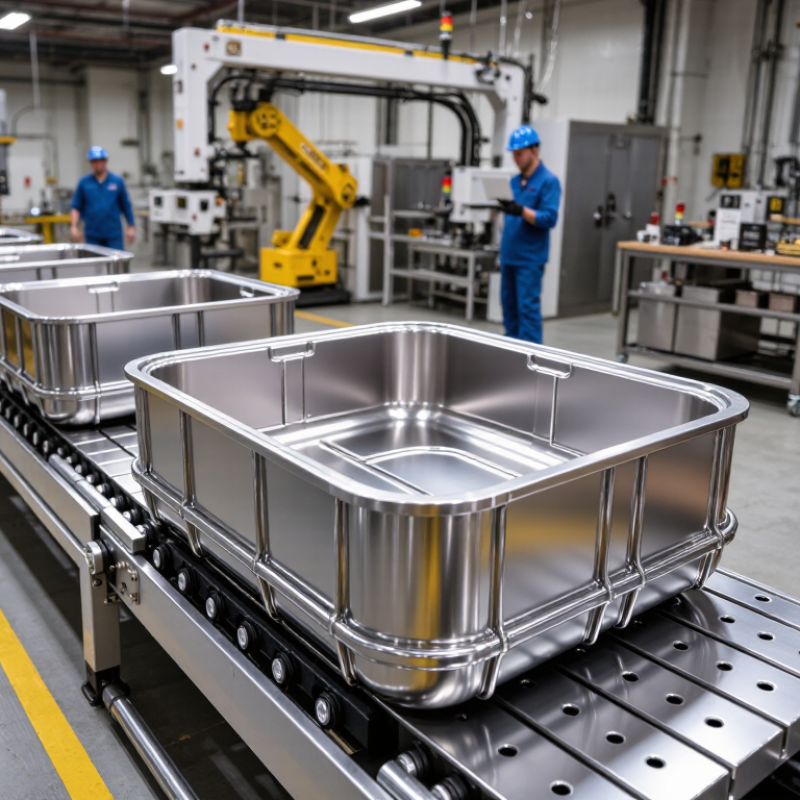
| Tub forming | Multi-stage press forming or deep drawing with matched dies | Tub geometry, corner radii, flange shape, and repeatability | Measure critical dimensions and inspect for wrinkles, splits, and surface marks | Review die design, press capacity, changeover method, and first-piece approval process. |
| Edge and flange finishing | Trimming, hemming, and precision flange forming | Edge profile, fit-up, and the interface for seals or adjoining panels | Inspect flange dimensions, edge finish, and part-to-part fit | Ask how tooling wear and dimensional variation are monitored during production. |
| Seam joining | Resistance spot welding, seam welding, or another process selected for the tub design | Joint strength, seam continuity, heat effects, and potential leak paths | Use visual inspection and a suitable leak or joint test defined by the product design | Check weld-fixture repeatability, process monitoring, and the response to failed tests. |
| Surface protection | Material-specific cleaning, passivation, coating, or other approved surface treatment | Corrosion resistance, cleanliness, and compatibility with detergents and operating conditions | Verify treatment records and carry out the product-specific corrosion or surface checks | Confirm that treatment requirements match the selected tub material and product specification. |
| Component assembly | Dedicated fixtures, controlled fastening, and automated or guided component placement | Positioning of seals, brackets, insulation, and other tub-related components | Check component presence, orientation, fastening records, and assembly dimensions | Evaluate error-proofing, traceability, and access for maintenance or line changeovers. |
| End-of-line inspection | Dimensional checks, leak testing, and documented inspection plans | Conformance of the completed tub assembly to drawing and product requirements | Review test method, calibration records, results logging, and nonconformance handling | Confirm that acceptance limits are defined by the product design and validated test method. |
| System and safety documentation | Documented quality controls and applicable product-safety testing | Consistency between manufacturing controls and the finished dishwasher requirements | Review the applicable edition and scope of standards, such as IEC 60335-2-5 for dishwasher safety | Standards applicability depends on the product, market, and conformity-assessment route. |



 08045479132
 Send Inquiry

 Send Inquiry
 Send SMS