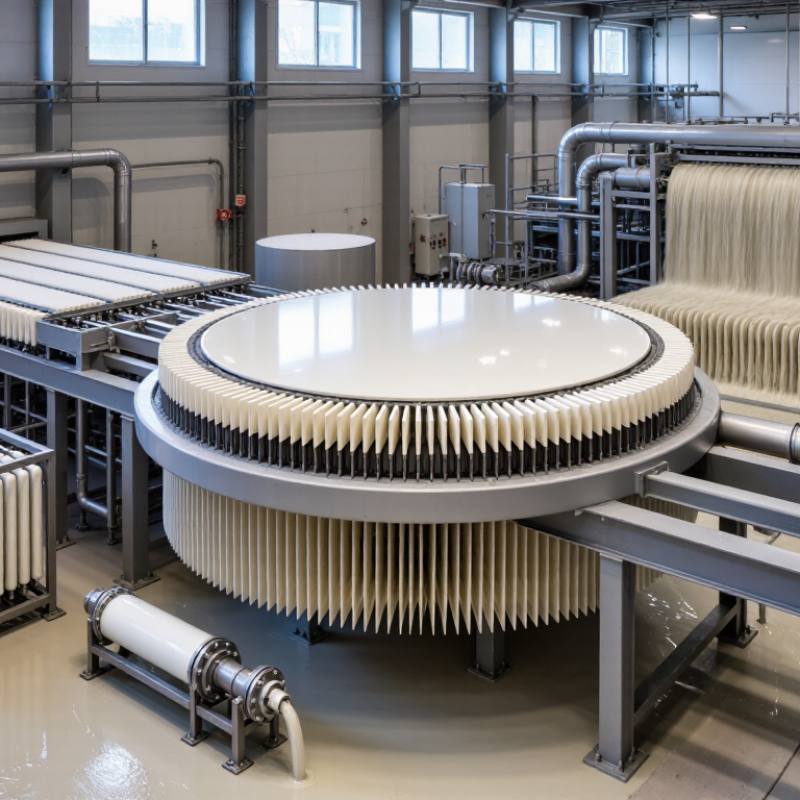
| Rotary ceramic disc filter | Porous ceramic sectors mounted on rotating discs pass through a slurry. Vacuum draws filtrate through the ceramic and leaves a solids cake on the surface; the cake is discharged as each sector moves through the operating cycle. | Continuous dewatering of suitable mineral and other process slurries where a steady feed is available. | Continuous operation; reusable ceramic elements; potentially low filtrate solids when the feed and element pores are well matched. | Performance depends on slurry properties, cake behavior, element condition, and operating settings. Ceramic elements require suitable cleaning and careful handling. | A continuous-duty installation needs a common, established ceramic-filter arrangement and the slurry forms a filterable cake. |
| Fine-pore ceramic element selection | The ceramic element’s pore structure provides the filtration medium. Vacuum pulls liquid through the interconnected pores while solids are retained at the surface or within the cake layer. | Feeds where filtrate clarity and retention of fine particles are important. | Can help reduce solids carryover when the pore structure is appropriate for the particle-size distribution. | Very fine or blinding-prone feeds may reduce filtration rate or require more frequent cleaning. Pore size should be chosen using slurry tests, not clarity targets alone. | Fine-particle retention is a priority and representative pilot testing confirms acceptable capacity and cleanability. |
| Higher-area disc arrangement | Uses more available ceramic filtration area within the selected equipment footprint or a larger filter arrangement. The basic vacuum filtration cycle remains the same. | Applications requiring greater continuous filtration capacity, subject to the slurry’s cake-forming behavior. | Additional area can increase potential throughput when filtration area is the limiting factor. | More area does not guarantee higher production if feed concentration, cake resistance, vacuum conditions, or downstream handling is limiting. | Trials or operating data show that available filter area—not another process constraint—is limiting capacity. |
| Ultrasonic-assisted cleaning configuration | Ultrasonic energy is used during a cleaning step to help remove deposits from ceramic pores and surfaces; it supplements, rather than replaces, the filtration cycle. | Service where residual deposits or pore blinding are confirmed operational problems and the equipment supports this cleaning method. | May help restore permeability when deposits respond to the chosen cleaning method. | Cleaning effectiveness depends on the deposit, chemistry, equipment design, and procedure. It adds system complexity and should be validated for the specific element. | Cleaning trials identify persistent deposits that are not adequately managed by the existing approved cleaning routine. |
| Feed- and cake-matched configuration | Element choice and operating conditions are selected using representative slurry tests, including solids concentration, particle size, viscosity, and cake release behavior. | Variable, abrasive, fine, or otherwise difficult-to-filter process feeds. | Connects equipment selection to actual process behavior rather than relying on a generic capacity claim. | Requires representative samples and testing across realistic operating conditions; results can change if the feed changes. | Reliability, product moisture, or throughput targets are important and feed properties are not yet well characterized. |



 08045479132

 Send Inquiry


 Send Inquiry
 Send SMS

