| Power and voltage | Electric models are commonly offered for 100–120 V / 60 Hz or 220–240 V / 50 Hz markets. Rated wattage varies by model. | Confirm the voltage, frequency, plug type, and rated power shown on the product label and specification sheet. | Choose the correct electrical version for the destination market; do not assume a plug adapter changes voltage or frequency. |
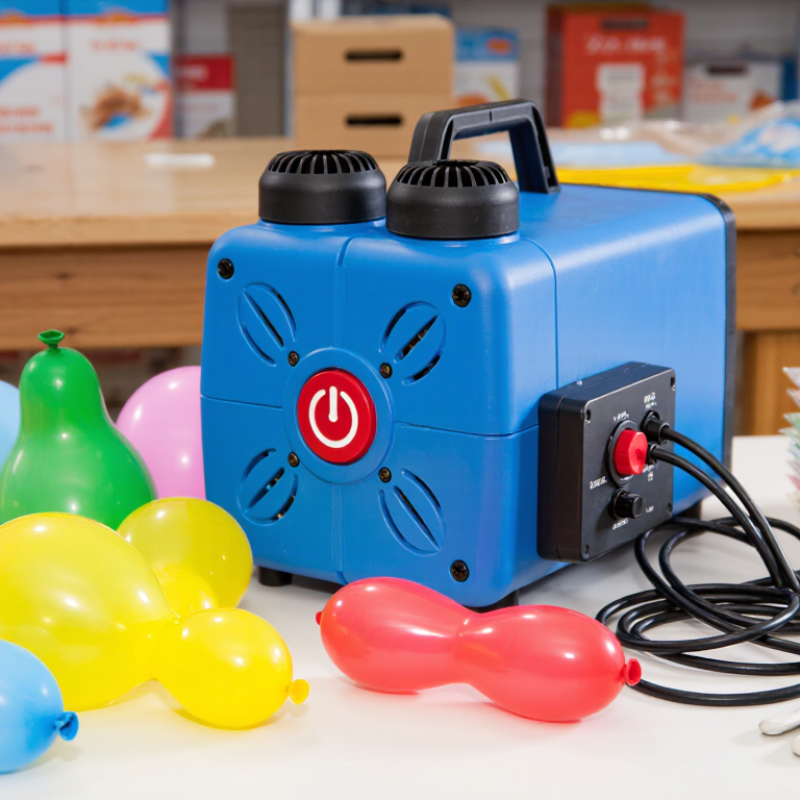
| Inflation controls | Common configurations include push-to-inflate operation, continuous operation, or both. | Test whether the switch is clear and easy to operate, and whether continuous mode has suitable operating instructions. | A push-to-inflate mode can help users control individual balloons; continuous mode can be useful for repetitive decorating work. |
| Nozzle configuration | Single- and dual-nozzle designs are available. Nozzle shape and diameter differ between models. | Check nozzle fit with the balloon necks used by your customers, and inspect nozzle durability and replacement availability. | A dual-nozzle design may support faster handling, but confirm that both outlets work as intended in a sample test. |
| Balloon compatibility | Electric balloon blowers supply air and are commonly used with air-fillable latex balloons and suitable foil balloons. | Ask for the stated balloon types and size range. Test representative balloon sizes before placing a bulk order. | An air blower does not fill balloons with helium and should not be marketed as a helium inflation device. |
| Operating time and thermal protection | Permitted run time and cooling requirements are model-specific; some products specify rest periods or thermal protection. | Request the duty-cycle instructions, overheat-protection details, and test conditions from the supplier. | Do not treat continuous operation as unlimited use. Follow the manufacturer’s stated run and cooling periods. |
| Noise and stability | Noise level and vibration depend on the motor, housing, and surface; test conditions are not always stated. | Request a noise measurement with its distance and test conditions, then assess the unit on a stable surface. | Use a working sample to check whether the blower moves, rattles, or becomes uncomfortable to use during repeated inflation. |
| Safety and market compliance | Applicable electrical safety and conformity requirements vary by sales destination. | Verify the relevant documentation for the destination market, including model details, test reports, and required markings. | Check that documents match the exact model and electrical version being ordered; a marking alone is not a substitute for verification. |
| Packaging and shipping | Carton dimensions, units per carton, gross weight, and packaging materials vary by order configuration. | Obtain carton measurements and gross weight before calculating freight, storage, and landed cost. | Request packaging details for the actual order quantity and confirm protection against impact during transport. |
| Quality control and sample testing | Inspection plans and acceptance criteria should be agreed between buyer and supplier. | Test startup, inflation controls, airflow consistency, cord condition, housing, and operation after repeated use. | Approve a production sample and document inspection criteria before confirming a large order. |
| Wholesale terms and after-sales support | Minimum order quantity, lead time, warranty, spare parts, and payment terms are supplier-specific. | Get each term in writing, including defect handling, replacement parts, and the process for warranty claims. | Compare total landed cost and support terms, not unit price alone. |



 08045479132
 Send Inquiry

 Send Inquiry
 Send SMS