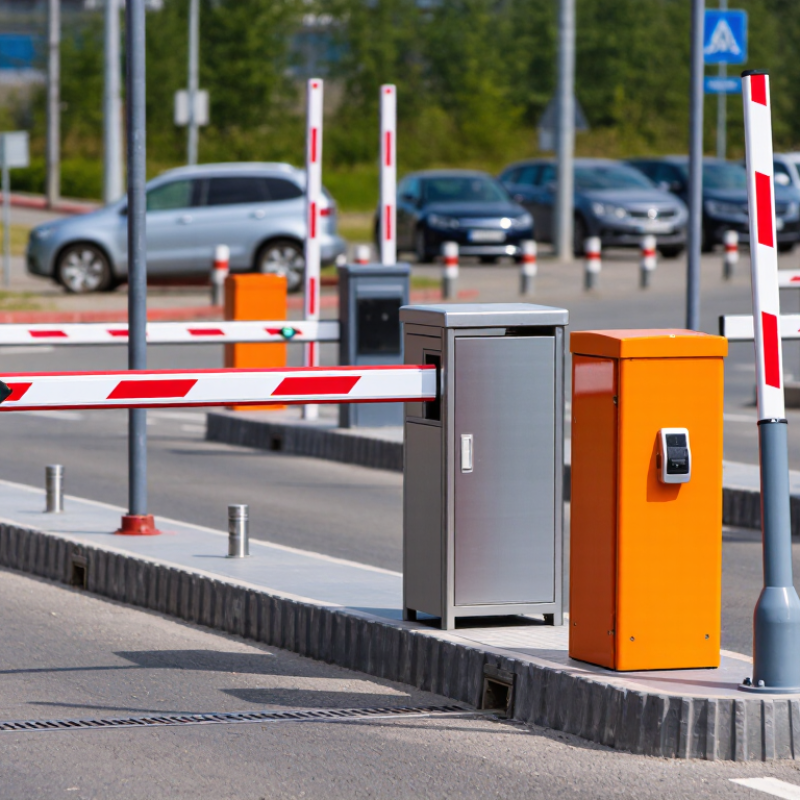
| 1. Automatic boom barrier | An electric motor raises and lowers a horizontal arm to control vehicle passage. | Parking entrances, residential driveways, and controlled access lanes. | Clear visual indication and straightforward lane control. | Arm length, wind exposure, duty cycle, and lane width affect selection. | Keypad, card reader, vehicle loop detector, photoelectric sensor, and manual release. |
| 2. Folding-arm barrier | A jointed arm folds as it opens, reducing the vertical clearance needed above the barrier. | Indoor parking facilities, garages, and entrances with low overhead clearance. | Can operate where a full-length straight arm would be obstructed by a ceiling or structure. | The folding mechanism needs suitable clearance and routine inspection. | Access reader, loop detector, obstruction sensing, and emergency release. |
| 3. High-duty-cycle boom barrier | A powered arm opens and closes repeatedly; the operator is selected for frequent operation. | Busy parking facilities, commercial sites, and access lanes with frequent vehicle movements. | Designed for heavier use than a system intended for occasional operation. | Confirm the rated operating cycle, maintenance schedule, and expected traffic volume with the installer. | Vehicle detection, safety sensors, status indicators, and monitored access controls. |
| 4. Automatic rising bollards | Vertical posts rise from and retract into ground-level housings to restrict vehicle access. | Pedestrian zones, building entrances, and sites requiring access control without a swinging arm. | A compact footprint when retracted and no overhead arm across the lane. | Requires suitable foundations, drainage, and access for servicing below ground. | Credential reader, traffic signals, vehicle detection, and emergency operation provisions. |
| 5. Automatic road blocker | A powered roadway platform or blocking element rises from a recessed foundation to prevent vehicle passage. | Restricted vehicle entrances where a substantial physical access-control measure is needed. | Can provide a more substantial physical obstruction than a standard access arm. | Requires civil works, drainage, careful traffic planning, and a site-specific security assessment. | Access control, traffic lights, vehicle detection, and coordinated emergency procedures. |
| 6. Automatic wedge barrier | A wedge-shaped barrier rises from a roadway recess to block vehicles at a controlled entrance. | Sites requiring a vehicle barrier integrated into the road surface. | Retracts below or near road level when access is permitted, depending on the design. | Foundation design, drainage, road layout, and access for maintenance are important. | Traffic signals, vehicle presence detection, access credentials, and emergency controls. |
| 7. Automatic sliding gate | A powered gate moves horizontally along a track or a cantilevered support to open or close an entrance. | Residential, commercial, and industrial vehicle entrances with space beside the opening. | The gate does not swing into the driveway or roadway. | Needs lateral space, a suitable foundation, and safeguards around moving and trapping points. | Photocells, safety edges, intercom, keypad, and vehicle detection. |
| 8. Automatic swing gate | One or two powered leaves rotate on hinges to open and close the entrance. | Driveways and entrances with adequate space for the gate leaves to swing. | Can suit sites where a sliding gate cannot move sideways along the boundary. | Check swing clearance, ground slope, wind loading, hinge condition, and pedestrian safety. | Photoelectric sensors, safety edges, access keypad, intercom, and manual release. |
| 9. Automatic telescopic sliding gate | Multiple connected gate sections slide and overlap to reduce the side space needed when open. | Vehicle entrances where a conventional sliding gate lacks sufficient run-back space. | Provides a wide opening with a shorter overall travel area than a single sliding leaf. | More moving components require correct alignment and regular maintenance. | Safety photocells, protective edges, access reader, and vehicle presence detection. |
| 10. Integrated gate-and-barrier system | A powered gate provides the main physical closure while an access barrier or control device manages vehicle flow. | Managed entrances with separate entry authorization, traffic control, or layered access procedures. | Combines a physical gate with lane-level access control in one coordinated layout. | Controls must be properly coordinated to prevent conflicting movements or unsafe operation. | Interlocked controls, credential readers, vehicle detection, safety sensors, and emergency release. |



 08045479132

 Send Inquiry


 Send Inquiry
 Send SMS

