| Absorption Capacity | A practical range is approximately 800–3,000 mL, depending on product size, core design, and intended use. | Fluff pulp combined with superabsorbent polymer, with an absorbent core distributed evenly across the product. | Check the declared capacity and laboratory results. Capacity should be evaluated using a recognized test method, such as ISO 11948-1, rather than by product weight alone. |
| Absorption Speed | Liquid should be absorbed quickly, with minimal pooling on the surface. | High-quality superabsorbent polymer, a well-designed acquisition layer, and effective liquid-distribution channels. | Review repeated acquisition-time and strike-through test results. A suitable product should continue absorbing after several liquid applications. |
| Rewet Performance | The surface should remain comparatively dry after pressure is applied to the absorbent core. | Well-bonded absorbent materials, a dry-touch topsheet, and sufficient superabsorbent polymer. | Ask for rewet test data after absorption. Lower rewet values generally indicate better dryness and reduced skin exposure to moisture. |
| Leakage Protection | The product should provide protection during normal movement, sitting, and nighttime use. | Raised elastic leg cuffs, a leak-guard barrier, a waterproof breathable backsheet, and an absorbent core that reaches the side areas. | Review standing, sitting, movement, and overnight leakage test results. Inspect the leg cuffs and barrier height on physical samples. |
| Fit and Size Accuracy | The waist and leg openings should fit securely without excessive compression or visible gaps. | Clearly defined waist-size ranges, stretch panels, elastic leg gathers, and symmetrical construction. | Compare the actual waist range with the product specification. Test several body shapes because nominal size labels are not fully standardized across manufacturers. |
| Breathability | The outer layer should allow water vapor to escape while maintaining liquid resistance. | Breathable nonwoven materials and a microporous backsheet. | Request water-vapor transmission and hydrostatic-pressure test results. Breathability should be assessed together with leakage resistance. |
| Skin Comfort | The inner surface should be soft, smooth, and free from rough seams or hard edges. | Soft spunbond or similar nonwoven topsheet, low-friction materials, smooth elastic bonding, and an appropriate pH-balanced design. | Inspect the topsheet by touch and check skin-irritation or biocompatibility evaluation documents where available. No disposable diaper can guarantee zero irritation for every user. |
| Odor Control | The product should reduce unpleasant odor without relying on excessive fragrance. | Odor-adsorbing materials or controlled odor-management technology, preferably with a fragrance-free option. | Check ingredient disclosures and odor-control test results. Fragrance-free products may be preferable for users with sensitive skin. |
| Fastening System | Tabs should open and reattach repeatedly without tearing the main sheet. | Wide hook-and-loop tabs, strong landing zones, and reinforced side panels. | Open and refasten the product several times. Check whether the tabs maintain grip after adjustment and whether the side panels remain intact. |
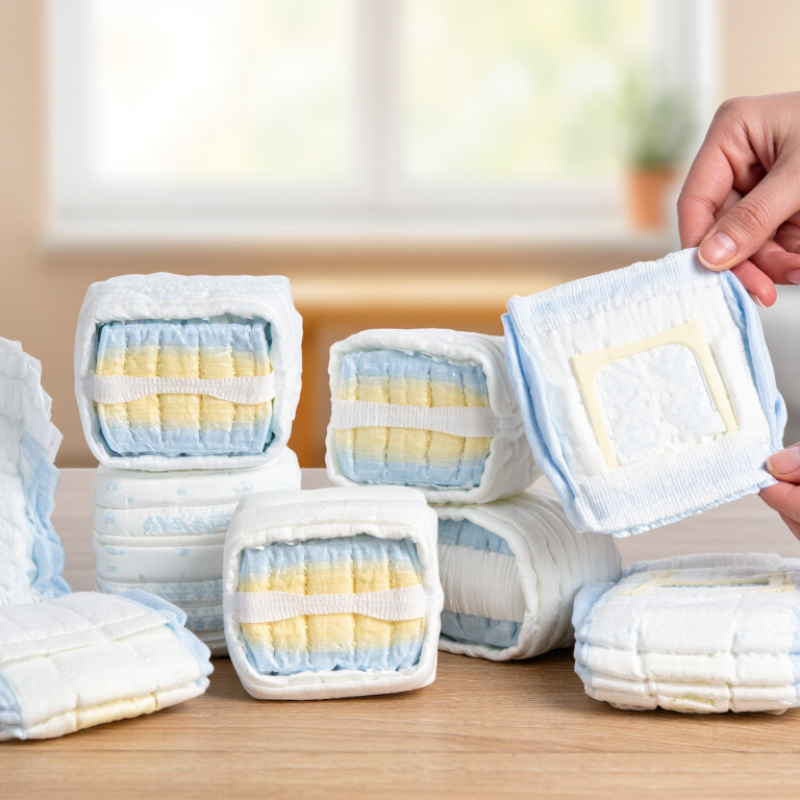
| Core Construction | The absorbent core should remain evenly distributed and should not form large lumps during use. | Uniform pulp preparation, controlled polymer distribution, core embossing, and reliable adhesive bonding. | Inspect the core before and after absorption. Excessive clumping, empty zones, or material migration indicate weaker construction. |
| Tear Strength and Durability | The diaper should withstand normal lifting, walking, sitting, and repositioning without tearing. | Strong side panels, stable seams, elastic reinforcement, and consistent adhesive application. | Review tensile and seam-strength test data and perform practical movement tests with representative users. |
| Safety and Chemical Control | Materials should comply with applicable Chinese product-safety requirements and contain no prohibited substances above permitted limits. | Controlled raw-material sourcing, suitable inks and adhesives, and documented production quality controls. | Request current third-party test reports, material declarations, and conformity documentation for the applicable Chinese standard, including GB/T 28004.1-2021 where relevant. |
| Microbiological Hygiene | The finished product should meet applicable hygiene and microbiological limits for disposable sanitary products. | Clean production areas, controlled raw materials, sealed packaging, and documented sanitation procedures. | Review batch-based microbiological test reports and manufacturing hygiene records. Testing should be performed by a qualified laboratory. |
| Packaging Protection | Individual or multipack packaging should remain sealed, dry, clean, and undamaged during storage and transport. | Moisture-resistant packaging, secure seals, production-date coding, and traceable batch information. | Check packaging integrity, lot numbers, manufacturing dates, storage instructions, and carton compression performance. |
| Manufacturing Consistency | Absorption, dimensions, fastening strength, and leakage performance should remain consistent from batch to batch. | Automated production controls, incoming-material inspection, in-process checks, and final sampling procedures. | Request certificates of analysis, inspection plans, defect-rate records, and samples from more than one production batch. |
| User Information | Instructions should clearly explain sizing, application, changing frequency, disposal, and storage. | Readable multilingual labeling, waist measurements, absorbency category, usage illustrations, and disposal guidance. | Confirm that the label matches the actual product and includes traceable manufacturer, batch, and compliance information where required. |
| Environmental Considerations | The product should provide transparent information about material composition and packaging recyclability. | Efficient material use, reduced packaging, responsibly sourced pulp where documented, and packaging with clear disposal instructions. | Review material declarations and environmental claims. Avoid claims such as “biodegradable” or “compostable” unless supported by recognized testing and certification. |



 08045479132

 Send Inquiry


 Send Inquiry
 Send SMS

