| Chain-Link Fence Weaving Machine | Weaves wire into a continuous diamond-pattern mesh, which is cut to the required roll length. | Galvanized or plastic-coated steel wire; finished mesh is commonly supplied in rolls. | Residential boundaries, sports areas, commercial sites, and perimeter security. | Check the supported wire diameters, mesh opening range, roll width, changeover requirements, and whether automatic cutting or winding is included. |
| Welded Wire Fence Panel Line | Feeds longitudinal and cross wires into a grid, resistance-welds their intersections, and cuts panels to length. | Low-carbon or galvanized steel wire; coating may be applied before or after welding, depending on the line and product specification. | Welded mesh panels, garden fencing, partition panels, and some livestock or industrial enclosures. | Verify wire-feed configuration, panel width and length range, mesh spacing, welding capacity, and the electrical supply required. |
| Field Fence Weaving Machine | Joins horizontal and vertical wires to form knotted or hinged-joint mesh, often with varied spacing between horizontal wires. | Galvanized steel wire, usually supplied on wire coils. | Farm boundaries, pasture, ranch fencing, and livestock enclosures. | Match the machine to the required knot style, wire gauge, fence height, wire spacing, and intended livestock use. |
| Barbed Wire Making Machine | Twists line wires together and secures barbs at regular intervals to make barbed wire. | Galvanized steel line wire and barb wire. | Agricultural boundaries and perimeter fencing where a barbed-wire design is permitted and appropriate. | Confirm line-wire and barb-wire diameter ranges, barb spacing, twist pattern, coil take-up, and applicable local safety rules. |
| Razor Wire Coiling Machine | Forms concertina or straight razor-wire coils from metal strip and core wire; some configurations also clip adjacent loops together. | Usually galvanized or stainless-steel strip with a supporting core wire. | Restricted-access and high-security perimeter installations, subject to local regulations. | Check compatible strip profiles, coil diameter, clipping method, guarding, and safety procedures for handling sharp material. |
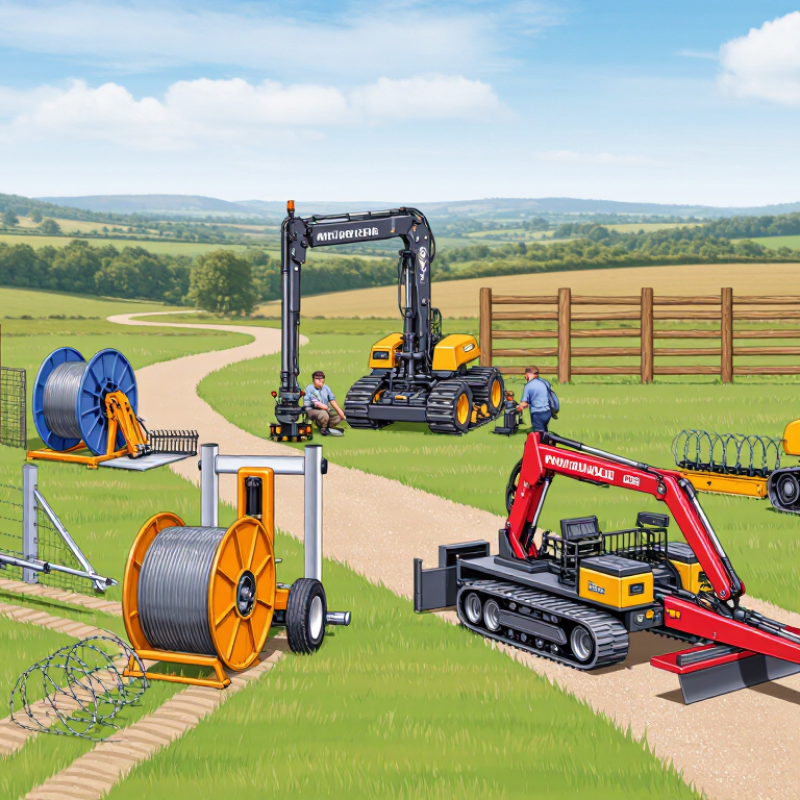
| Fence Post Driver | Uses impact force to drive posts into the ground, with handheld, tractor-mounted, skid-steer, or excavator-mounted configurations available. | Timber, steel, or other compatible posts, depending on the driver and attachment. | Farm, ranch, roadside, and site fencing where posts can be driven into suitable ground. | Compare carrier compatibility, post-size range, impact energy, access conditions, soil and rock conditions, and operator safety features. |
| Post-Hole Auger | Rotates an auger bit to drill holes for fence posts; available as handheld or machine-mounted equipment. | Ground is drilled rather than processed; bit choice depends on soil conditions and hole dimensions. | Fence installation where posts are set in prepared holes, including installations in ground unsuitable for direct driving. | Match the power source, mounting system, bit diameter and length to the post design; account for soil, stones, utilities, and required hole depth. |



 08045479132

 Send Inquiry


 Send Inquiry
 Send SMS

