2026 Top Long Range RFID Readers for Global Buyers?
Global buyers entering the 2026 RFID market face a practical question: which Long Range Rfid reader can deliver stable identification across warehouses, yards, retail floors, and production areas? This guide introduces leading options by comparing read distance, antenna performance, tag compatibility, connectivity, environmental protection, and integration effort. A long reading distance alone does not guarantee useful data. Metal racks, liquid containers, moving forklifts, and poor tag placement can reduce performance quickly.
Mark Roberti, founder of RFID Journal, has emphasized, “RFID is not a technology problem; it is a business process problem.” His point remains relevant for international buyers. The strongest reader is not always the most expensive model. It must fit the workflow, local infrastructure, software architecture, and maintenance skills available at the site. A reader that performs well in a quiet laboratory may struggle beside conveyor motors or dense pallet stacks.
This overview focuses on measurable factors. These include tested read range, multi-tag accuracy, operating temperature, IP protection, frequency support, PoE or serial connectivity, and API availability. It also considers deployment evidence from logistics, manufacturing, healthcare, and retail environments. Details matter here. A loading gate may need fast tag capture within two seconds. A warehouse aisle may require narrower antenna control to reduce unwanted reads. Some recommendations may change after a pilot test. That is normal. RFID planning is rarely perfect on the first attempt. Real products also vary by region, firmware, antenna design, and approved frequency bands.
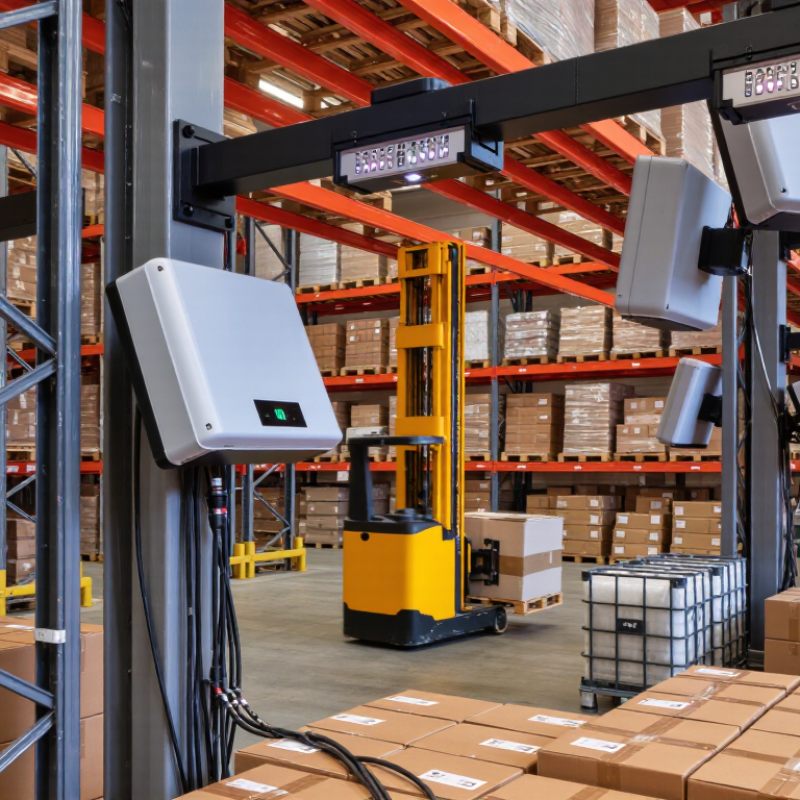
What Long-Range RFID Readers Are and How They Work
Long-range RFID readers identify tagged objects without requiring direct line of sight. Most use passive UHF RFID between 860 and 960 MHz, following the ISO/IEC 18000-63 framework. The reader sends radio energy through one or more antennas. A nearby tag reflects a modulated signal, called backscatter, carrying its stored identification data. In open warehouse conditions, passive tags may read from roughly 3 to 12 meters. Actual distance changes with antenna gain, tag design, mounting angle, and local frequency rules.
At a loading dock, an antenna can scan cartons as a pallet crosses the doorway. Software then filters repeated reads and links each tag to a shipment record. Metal racks can create reflections. Liquids can weaken the signal. A poorly positioned tag may disappear for several seconds. These details matter more than a headline range figure. The RAIN Alliance reported 52.5 billion RAIN tags shipped globally in 2023, showing the scale of adoption across logistics and retail. GS1 implementation guidance also stresses tested placement, controlled read zones, and verified data accuracy.
Global buyers should check regional operating bands, reader sensitivity, antenna polarization, connection options, and environmental ratings. Ethernet with power delivery can simplify installation, but wireless setups may suit temporary sites. A practical pilot is still necessary. Specifications are useful, yet real pallets are messy. Even experienced teams can overestimate performance when testing with empty boxes.
Key Specifications for Comparing Long-Range RFID Readers
For 2026, global buyers should compare long-range RFID readers by measurable specifications, not advertised distance. Read range depends on reader sensitivity, antenna gain, tag design, orientation, and local power limits. EPCglobal Class 1 Gen 2 and ISO/IEC 18000-63 support broad supply-chain compatibility. However, protocol compliance alone does not guarantee reliable performance.
A practical comparison starts with receiver sensitivity, transmit power, antenna ports, polarization, and read-rate stability. Four-port readers can cover dock doors more evenly, while circular polarization handles moving cartons with changing tag angles. Check operating bands carefully, because regional UHF allocations and power rules differ. The RAIN Alliance reported approximately 33.7 billion RAIN RFID tags sold in 2023, showing strong global adoption. Still, high deployment volume does not remove installation challenges. Metal racks, liquid containers, and reflective flooring can create missed reads.
Tips: Test the complete system with real cartons, not an open-air tag. Measure read accuracy, not only maximum distance. Record performance at different speeds, temperatures, and pallet positions. Keep at least 20 percent range margin for seasonal changes and imperfect tag placement. This margin may feel excessive. In practice, it often prevents expensive redesigns. Buyers should also request sensitivity data, supported regional channels, API documentation, security controls, and independent test results. The best reader is rarely the one with the longest single read. It is the one that performs consistently at the busiest doorway.
2026 Top Long-Range RFID Readers for Global Buyers
Key Specifications for Comparing Passive UHF RFID Reader Performance
The chart shows typical maximum read distances for passive UHF RFID deployments using EPCglobal Class 1 Gen 2 / ISO 18000-63 tags. Open-air readings can reach approximately 25 metres, while metal-rich environments and dense item placement usually reduce range because of RF absorption, reflection, and tag detuning. Actual performance depends on antenna gain, reader transmit power, tag design, mounting height, polarization, and local UHF regulations.
Global buyers should also verify regional operating bands, typically 865–868 MHz in Europe and 902–928 MHz in North America, along with supported interfaces, IP protection, operating temperature, and regulatory certification.
Leading Long-Range RFID Reader Types for Global Applications in 2026
Long-range RFID readers support demanding operations across warehouses, transport yards, manufacturing sites, and retail distribution centers. In 2026, the strongest choice depends on tag placement, reading distance, interference, and regional radio requirements.
Fixed UHF readers suit dock doors, conveyor lines, and storage aisles. Multiple antenna ports can create controlled reading zones around pallets and cartons. Portal readers add synchronized antennas and motion sensors for vehicle or package checkpoints. They reduce manual scanning. However, metal racks and liquid containers can weaken signals, even when the reader has high output power.
Handheld long-range readers help workers locate tagged assets across wide facilities. A clear display, balanced grip, and replaceable battery matter during long shifts. Vehicle-mounted readers fit forklifts and yard trucks, capturing tag data while equipment moves slowly between lanes. Some applications need active or battery-assisted tags when passive tags cannot reach the required distance. That choice costs more. Sometimes, it is necessary.
Experienced integrators test readers with the actual tags, packaging, shelving, and network conditions. A laboratory distance claim rarely matches a crowded warehouse. Regional frequency rules, permitted power levels, data security, and worker privacy must guide deployment. Start with a small zone. Measure missed reads, duplicate reads, and response time. The results may challenge the original design, which is useful. A powerful reader is not automatically a reliable reader.
Regional Standards, Frequencies, and Compliance Requirements
Choosing a long-range RFID reader in 2026 requires more than comparing reading distance. Regional radio standards decide whether the equipment can operate legally and reliably. UHF RFID commonly uses 865–868 MHz in much of Europe, 902–928 MHz in North America, and different channel plans across Asia-Pacific markets. These ranges are not interchangeable. Power limits, channel spacing, and permitted duty cycles can vary within nearby countries.
A reader designed for one region may lose performance after entering another. European installations often follow ETSI requirements, while North American systems typically follow FCC rules. Japan, China, Australia, and Southeast Asian markets may require separate frequency settings or local certification. Check the allowed EIRP or ERP, occupied bandwidth, frequency-hopping rules, and spurious-emission limits. A warehouse near a metal loading door can also create reflections and missed reads. Real testing matters.
I have seen teams choose antennas first and regulations later. That order causes expensive redesigns. Ask the supplier for current conformity documents, test reports, firmware region controls, and country-specific approval records. Confirm the reader, antenna gain, cable loss, and output power as one complete installation. Indoor and outdoor limits may differ. Border operations need extra care. A regional map is never enough. Standards can change, and technical assumptions can age quickly. When uncertain, consult the destination country’s radio authority before deployment, not after the equipment arrives.
Selection Factors for Buyers Across Different Industries
Choosing a long-range RFID reader requires more than comparing maximum distance. The 2024 RAIN Alliance industry report placed annual RAIN RFID tag-chip shipments above 50 billion units. That scale reflects broad use across retail, logistics, manufacturing, healthcare, and asset tracking. Yet range changes with metal, liquids, packaging density, antenna placement, and local radio rules.
Retail buyers should prioritize fast inventory reads and reliable performance near shelving. Manufacturers need stable reads around machinery and tagged containers. Logistics operators may value wide portal coverage and motion tolerance. Healthcare facilities often need compact equipment, controlled power levels, and simple integration. Check regional frequency support, antenna polarization, read-rate testing, ingress protection, and software compatibility. A longer range is not always better. It may increase unwanted reads.
Tips: Test a reader with your real tags and materials. Measure missed reads, false reads, read time, and heat after continuous operation. Request independent laboratory results, not only vendor specifications. The Auburn University RFID Lab’s ARC testing program is useful for comparing tag performance, but reader selection still requires site trials. Also calculate total ownership costs, including antennas, cabling, mounting, integration, maintenance, and training. A cheaper unit can become expensive in a noisy warehouse. My practical concern is simple: buyers often test in an empty room, then deploy beside steel racks. That gap deserves more attention.



 08045479132

 Send Inquiry


 Send Inquiry
 Send SMS

