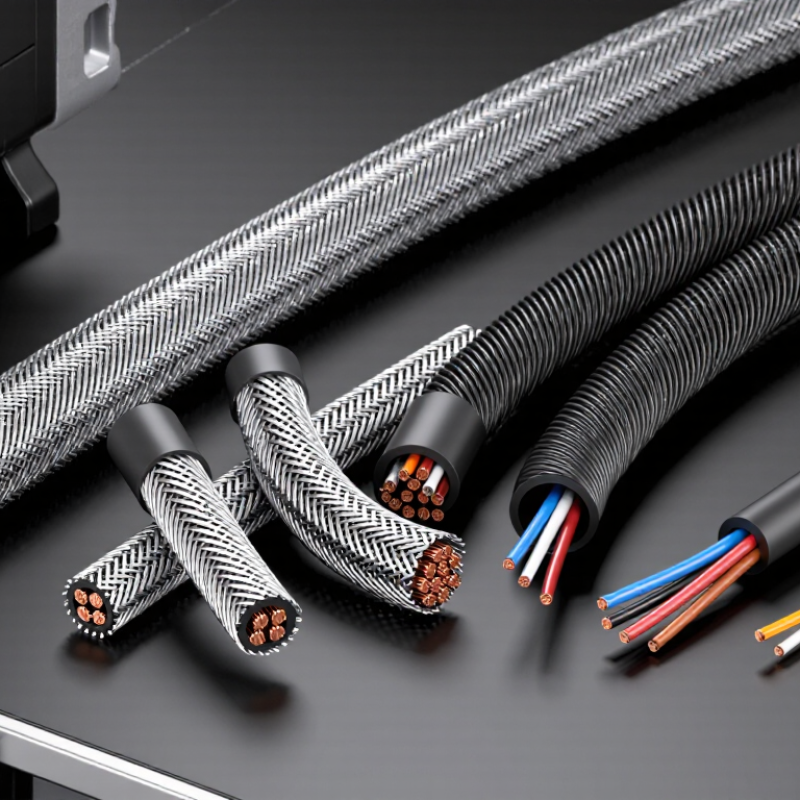
| Expandable Copper Braid | Tinned copper or bare copper strands | Provides a conductive Faraday cage around the wire bundle and carries induced currents to a grounded termination. | Approximately 60–95 dB in well-terminated assemblies; results vary with frequency, braid coverage, and installation. | Typically 85–95% visual coverage | High; expands over irregular bundles and bends easily | About −65°C to +200°C, depending on insulation and plating | Power electronics, industrial controls, robotics, and automotive harnesses |
| Nickel-Plated Copper Braid | Copper braid with nickel surface plating | Reflects and absorbs electric-field interference while maintaining a low-resistance conductive path. | Approximately 70–100 dB in properly bonded systems | Typically 85–95% visual coverage | High, with good resistance to repeated flexing | About −65°C to +260°C, depending on construction | High-temperature equipment, aerospace wiring, motors, and sensors |
| Stainless-Steel Braid | Stainless-steel filaments or fine metallic wire | Forms a conductive barrier that reduces radiated coupling and offers strong mechanical protection. | Approximately 50–85 dB, depending on braid density and grounding | Typically 80–95% visual coverage | Medium to high; generally stiffer than copper braid | About −70°C to +500°C for suitable high-temperature designs | High-abrasion areas, industrial machinery, exhaust zones, and harsh environments |
| Aluminum Foil Laminate Sleeve | Aluminum foil bonded to polyester film | Uses a continuous conductive layer to reflect high-frequency electric-field noise; foil overlap must remain electrically continuous. | Approximately 80–120 dB at higher frequencies when seams and drain wires are correctly terminated | Up to 100% surface coverage | Medium; less tolerant of repeated sharp bending than braid | About −40°C to +150°C, depending on laminate and outer jacket | Data cables, control panels, communication wiring, and compact electronic assemblies |
| Conductive Fabric Sleeve | Metal-plated textile fibers, often based on polyester or nylon | Creates a lightweight, flexible conductive enclosure that attenuates electric-field interference. | Approximately 40–80 dB, strongly dependent on fabric conductivity and closure design | Typically 80–95% effective textile coverage | Very high; suitable for tight bends and moving cable assemblies | About −40°C to +125°C, depending on textile composition | Portable electronics, medical equipment, display cables, and moving harnesses |
| Braid-and-Foil Dual Layer | Metal foil layer combined with copper or tinned-copper braid | Combines the continuous high-frequency barrier of foil with the mechanical strength, grounding reliability, and low-frequency performance of braid. | Approximately 90–120 dB in optimized assemblies across a broad frequency range | Up to 100% foil coverage plus 85–95% braid coverage | Medium; thicker and less flexible than a single-layer sleeve | About −40°C to +150°C, depending on the outer braid and insulation | Industrial drives, medical systems, test equipment, and high-noise environments |



 08045479132
 Send Inquiry

 Send Inquiry
 Send SMS
