| Trailer-Mounted Water Jetter | High-pressure water jetting with interchangeable nozzles | 100–600 mm | 100–280 bar | 40–180 L/min | 60–150 m high-pressure hose | 1,000–3,000 L | Routine drain maintenance, commercial properties, residential service work | Check towing requirements, pump material, hose-reel capacity, water refill method, and local road regulations. |
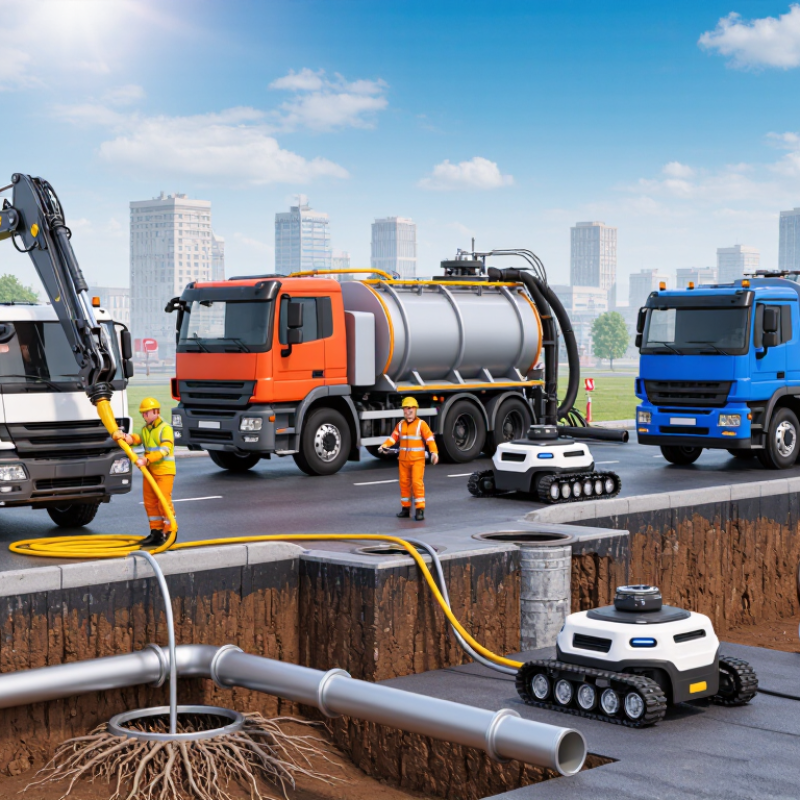
| Truck-Mounted Water Jetter | High-pressure jetting from a dedicated service vehicle | 150–1,200 mm | 120–350 bar | 100–450 L/min | 100–300 m hose; multiple nozzle configurations | 4,000–12,000 L | Municipal networks, long sewer runs, large commercial and industrial sites | Compare chassis payload, water-tank volume, pump efficiency, operator controls, winterization, and service access. |
| Combination Sewer Cleaner | High-pressure jetting combined with vacuum extraction | 150–1,800 mm | 120–350 bar | 100–500 L/min | 100–300 m jetting hose; suction hose commonly 100–150 mm diameter | Water tank: 3,000–12,000 L; debris tank: 3,000–15,000 L | Municipal sewer cleaning, catch basins, culverts, wet wells, and sludge removal | Evaluate fan or positive-displacement vacuum system, debris discharge method, tank separation, payload, and safety interlocks. |
| Vacuum Excavator and Sewer Suction Unit | Air or liquid vacuum removal of sludge, soil, and debris | Access pits, manholes, wet wells, and large sewer structures | Usually not rated by jetting pressure; vacuum commonly 0.4–0.9 bar below atmospheric pressure | Airflow commonly 2,000–8,000 m³/h | 6–20 m suction hose, depending on configuration | 3,000–12,000 L spoil capacity | Heavy debris removal, daylighting, manhole cleaning, and non-destructive excavation | Confirm suction depth, filtration, spoil handling, noise limits, ground conditions, and permitted disposal method. |
| Portable Electric or Petrol Drain Jetter | Compact high-pressure water cleaning | 50–300 mm | 80–200 bar | 25–100 L/min | 30–100 m hose | External water supply or 100–500 L auxiliary tank | Indoor facilities, narrow access areas, small commercial drains, and emergency response | Compare electrical protection, engine emissions, portability, noise, hose storage, and compatibility with local power supply. |
| Hydro-Mechanical Root-Cutting System | Water jetting combined with rotating root-cutting tooling | 100–600 mm | 140–280 bar | 60–250 L/min | 60–180 m hose; root-cutting and flushing nozzles | 1,000–6,000 L | Tree-root intrusion, recurring blockages, and difficult organic obstructions | Prioritize nozzle control, cutter durability, pipe-condition assessment, operator protection, and post-cleaning inspection. |
| CCTV Sewer Inspection and Cleaning Support System | Remote visual inspection before and after cleaning | 75–2,000 mm, subject to camera and crawler configuration | Not applicable; inspection equipment | Not applicable | Push camera: 30–60 m; crawler cable: commonly 100–300 m | Not applicable | Condition assessment, acceptance testing, blockage locating, and maintenance planning | Check camera diameter, lighting, pan-and-tilt capability, locating accuracy, recording format, and inspection software compatibility. |
| Robotic Sewer Cleaning and Milling System | Remote-controlled mechanical milling, cutting, or descaling | 150–1,200 mm | Tool-dependent; water-assisted systems commonly use 100–250 bar | Tool-dependent; commonly 30–150 L/min | 100–300 m control cable; modular cutting tools | Usually supplied by an external water or slurry-management unit | Concrete, mineral deposits, protruding connections, and localized structural obstructions | Assess remote-control range, tool torque, camera visibility, pipe-wall protection, recovery procedure, and operator training. |



 08045479132
 Send Inquiry

 Send Inquiry
 Send SMS