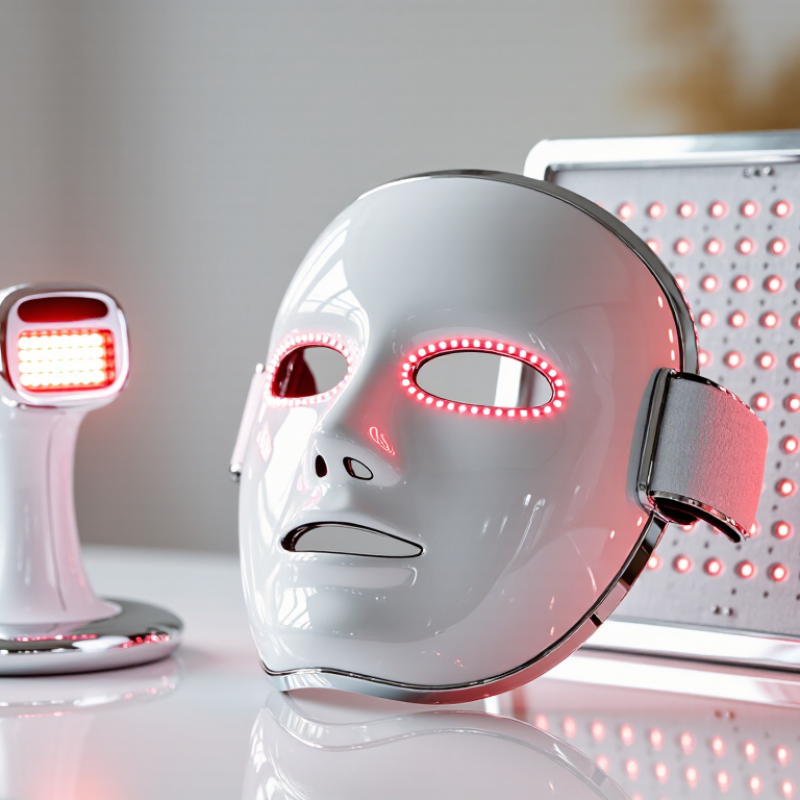
| Flexible LED face mask | Most of the face; coverage depends on mask shape and fit. | Red light commonly falls around 630–660 nm. Some models also include near-infrared light around 810–850 nm. | Check face fit, eye-area design, wavelength specifications, and whether light output is stated at the treatment surface. | Hands-free use and relatively even coverage when the mask sits properly. | Fit can vary by face shape. LEDs may sit at different distances from different areas of the face. |
| Rigid LED face mask | Broad facial coverage, with placement determined by the shell design. | Look for clearly specified red wavelengths; near-infrared is an optional additional band. | Assess comfort, weight, ventilation, secure positioning, eye protection guidance, and treatment instructions. | Maintains a fixed shape and may be easy to position consistently. | A fixed shape may not fit every face closely; storage and comfort can be less convenient. |
| Tabletop LED panel | Can illuminate the face and, depending on panel size and distance, nearby areas. | Commonly marketed red bands include 630–660 nm; near-infrared bands often include 810–850 nm. | Check recommended distance, beam coverage, irradiance measurement conditions, stability, and eye-safety instructions. | Adjustable distance and potential use across more than one body area. | Requires positioning and consistent distance; a larger panel may take up more space. |
| Handheld LED device | Small treatment area at a time. | Verify the exact wavelength or wavelengths rather than relying only on terms such as “red light.” | Review contact or distance instructions, treatment time per area, ergonomics, and output specifications. | Portable and easy to direct toward a specific area. | Coverage is slower and depends on careful, consistent placement across the face. |
| Multi-mode facial device | Varies; may combine LED light with other device functions. | Confirm which wavelength is used in each mode and whether modes can be selected separately. | Check mode-specific instructions, contraindications, eye-safety guidance, and whether each feature is clearly explained. | Offers more than one treatment function in a single device. | Additional features do not automatically mean better results; instructions may be more complex. |



 08045479132
 Send Inquiry

 Send Inquiry
 Send SMS