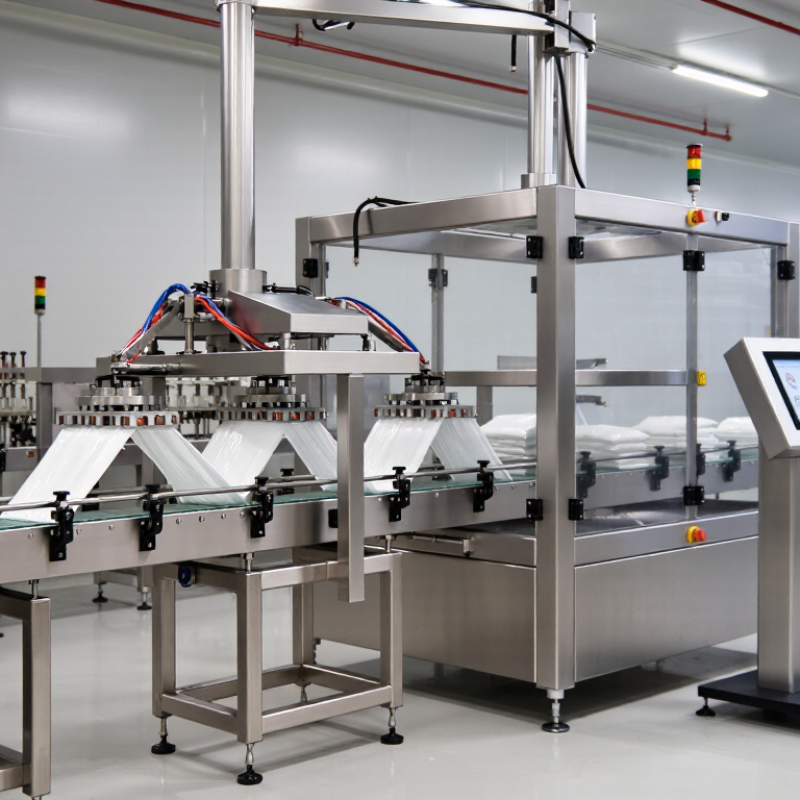
| Machine Definition | Automated system for separating, picking, opening, and transferring pre-made bags | An automatic bag feeding machine supplies empty bags to a filling, weighing, sealing, or packaging machine in a controlled sequence. It is different from a form-fill-seal machine, which makes bags from a continuous film roll. |
| Compatible Bag Types | Flat pouches, stand-up pouches, zipper bags, gusseted bags, and some spouted pouches | Compatibility depends on bag stiffness, opening design, zipper position, spout geometry, and the feeding grippers or vacuum cups used by the machine. |
| Typical Bag Width | Approximately 80–300 mm | The usable range varies by model. A buyer should confirm the minimum and maximum bag width, including the tolerances of the bag supplier. |
| Typical Bag Length | Approximately 120–400 mm | Longer bags may require a larger magazine, additional support, or a modified transfer path to prevent folding and misalignment. |
| Common Bag Material | Laminated plastic film, polyethylene, polypropylene, polyester laminates, aluminum-laminated film, and paper-laminate structures | Surface friction, static electricity, sealant layers, and bag stiffness directly affect separation and reliable feeding performance. |
| Typical Bag Thickness | Approximately 60–180 micrometres for many flexible pouches | Very thin bags can stick together, while thick or rigid bags may need stronger vacuum handling, wider grippers, or slower acceleration. |
| Standard Feeding Speed | Approximately 20–60 bags per minute | This range is common for general-purpose systems and depends on bag size, pouch construction, product line layout, and the number of handling stations. |
| High-Speed Feeding Capability | Approximately 60–100 bags per minute in optimized configurations | Higher speeds normally require stable bag dimensions, accurate magazine loading, synchronized controls, and reliable vacuum or mechanical separation. |
| Feeding Accuracy | Typically about ±1–2 mm under stable operating conditions | Actual positioning accuracy depends on bag quality, sensor resolution, conveyor design, servo tuning, and the interface with the downstream packaging machine. |
| Bag Magazine Capacity | Commonly 100–300 pre-made bags per loading cycle | Capacity is affected by bag thickness and compressed stack height. A larger magazine can reduce operator loading frequency but may increase machine footprint. |
| Bag Separation Method | Vacuum suction, friction belts, mechanical fingers, or combined systems | Vacuum handling is widely used for flexible bags. Mechanical separation can be useful when bags have difficult surfaces or when static electricity causes double feeding. |
| Compressed Air Requirement | Typically 0.5–0.7 MPa clean, dry compressed air | Air consumption should be checked in litres per minute because vacuum generators, pneumatic cylinders, and air knives can significantly affect the total requirement. |
| Electrical Power | Commonly about 2–5 kW, excluding some external equipment | Power demand varies with servo motors, vacuum pumps, conveyors, heaters, and the number of automated handling stations included in the system. |
| Control System | PLC control with touchscreen HMI, photoelectric sensors, and servo or variable-frequency drive control | Useful functions include recipe storage, bag-count monitoring, fault history, speed adjustment, sensor-status display, and communication with the filling or sealing machine. |
| Changeover Time | Approximately 10–30 minutes for common bag-size changes | Tool-free guides, digital recipe settings, clearly marked adjustment scales, and quick-release components can reduce changeover time and setup errors. |
| Typical Construction | Stainless steel 304 for exposed structural and product-contact areas; anodized aluminum or coated steel for selected non-contact components | Stainless steel 304 is widely used in food and general packaging environments. Stainless steel 316 may be selected for aggressive washdown or corrosive conditions. |
| Suitable Industries | Food, pet food, agricultural products, household chemicals, personal care, pharmaceuticals, and industrial components | The machine is suitable when products are packed in pre-made pouches and the production line requires consistent automatic bag presentation before filling or sealing. |
| Typical Product Applications | Snacks, coffee, powders, grains, frozen foods, sauces, detergents, wipes, pet treats, seeds, and small hardware | Product characteristics such as dust, oil, moisture, temperature, and particle size should be considered when selecting sensors, vacuum components, and cleaning methods. |
| Integration Equipment | Multihead weigher, linear weigher, auger filler, liquid filler, piston filler, checkweigher, metal detector, and case packer | The bag feeder should be matched to the cycle time, infeed height, discharge direction, communication protocol, and safety circuit of the complete packaging line. |
| Typical Machine Footprint | Approximately 1,200–2,500 mm long and 800–1,500 mm wide | Exact dimensions depend on magazine size, conveyor arrangement, bag-opening functions, and whether the unit is installed inline or at an angle to the main packaging machine. |
| Operating Environment | Generally 5–40°C with controlled humidity and a clean, stable floor | Dust, condensation, strong vibration, static electricity, and excessive humidity can reduce feeding reliability and shorten the service life of sensors and pneumatic parts. |
| Food-Safety Considerations | Cleanable surfaces, appropriate materials, protected lubricants, and hygienic machine design | For food applications, buyers should verify applicable local requirements, cleaning procedures, allergen-control measures, and the suitability of all product-contact components. |
| Safety Features | Emergency-stop circuits, guarding, interlocked access doors, overload protection, and fault alarms | Safety functions should be assessed against the regulations applicable in the installation country, such as machinery, electrical, and workplace safety requirements. |
| Common Feeding Faults | Double bags, missed pickup, skewed transfer, pouch collapse, zipper interference, and bag jams | Most faults are related to inconsistent bag dimensions, static charge, poor stack loading, unsuitable vacuum settings, worn suction cups, or incorrect guide adjustment. |
| Maintenance Items | Vacuum cups, belts, grippers, bearings, sensors, pneumatic filters, seals, and conveyor surfaces | Routine inspection and replacement of wear parts help maintain feeding accuracy. Cleaning frequency should reflect the product, dust level, and sanitation requirements. |
| Buyer Evaluation Priorities | Bag compatibility, stable speed, changeover flexibility, integration capability, safety, hygiene, serviceability, and total operating cost | The best machine is not necessarily the fastest model; it should reliably handle the buyer’s actual pouch samples, required output, labor conditions, utilities, and regulatory environment. |



 08045479132

 Send Inquiry


 Send Inquiry
 Send SMS

